Pricing MLB Cards Before the Lockout
This started as a list of MLB names to buy this offseason. It turned into a price board, because with a lockout coming, my answer on every name here right now is a pass.
That isn't a call on the players. Most of what I write about is prospects, and these are names that already made it. Every one of them had a season worth a second look. The timing is the problem, and I don't think I'm alone in seeing it that way. If enough collectors sit out the winter, that's exactly what could turn these into buys: prices that fall while nobody's playing.
The lockout changes the math
The collective bargaining agreement expires at 11:59 p.m. Eastern on December 1. Almost nobody around the game expects a deal by then. The league has already sent clubs a 34-page memo on how a lockout will run, and every proposal from the owners, including the 154-game season they floated on October 8, is tied to a salary cap the players won't discuss. The owners' first proposal in June put that cap at $245.3 million.
I wrote in August that I think at least half the 2027 season gets lost. I haven't changed my mind.
If that's right, loading up on big league cards in November doesn't make much sense. Current players are the part of the market most exposed to no games. Their cards move on box scores, highlights and Opening Day optimism, and a lockout takes away all three. Spring training games are scheduled to start February 19. Opening Day is March 25. If those dates pass with no baseball, I'd expect softer prices then than now.
The counter is real. No lockout has ever cost a regular season game. The last one ran 99 days, ended in March, and the card market mostly sat still through it. If this one settles at the deadline too, there's no dip, and the prices below were the discount. That's the risk of waiting.
How to read this
Prices are raw 1st Bowman autos as of mid-October, unless I say otherwise. Where I give an earlier price, it's roughly where the card sat in the spring or at its high for the year. Think of them as a marker for where each player's market sits today, so it's easy to tell later whether a lockout actually moved anything.
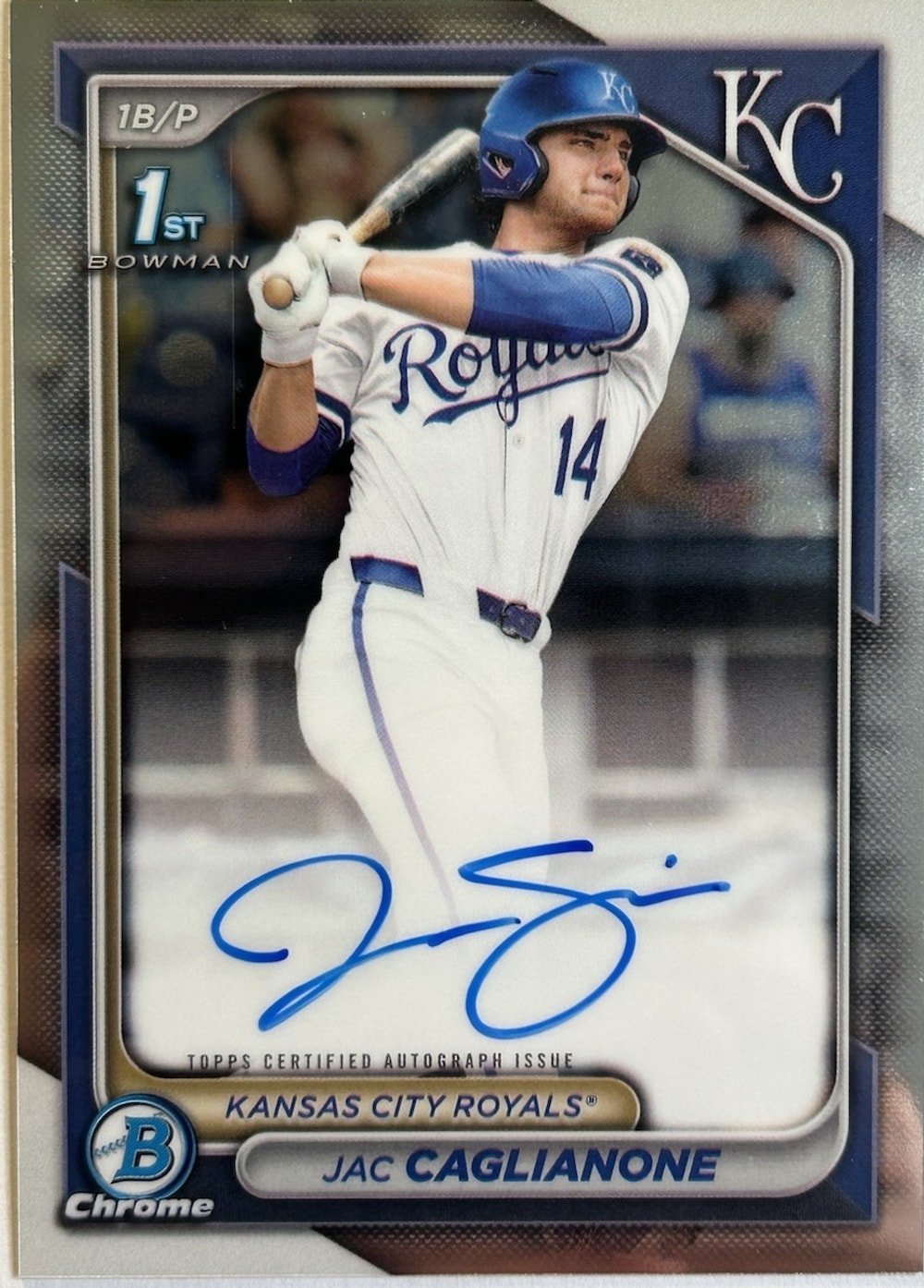
Jac Caglianone (KC, RF, 23)
A year ago this looked like a miss. Caglianone hit .157 with a .532 OPS over 62 games after his 2025 call-up.
Then he played 143 games in 2026 and hit .289/.340/.494 with 23 home runs. It wasn't a straight line. June was nine homers and a .649 slug. July was a .222 month with 19 strikeouts against two walks. August was .411/.429/.684 with six homers and 26 RBIs, the best OPS in the majors for the month, and it won him AL Player of the Month.
He struck out 144 times and walked 33, which works out to 26% and 6%. His manager's read on August was that he stopped chasing as much, and August was his lowest strikeout month at 18%. September was .327 with zero homers, and the strikeouts went back to 26%.
Here's what the card did while all of that happened. It was around $300 in March. It's about $232 now. He got better and the card got cheaper.
Where it sits: his raw 1st Bowman auto is about $232, down from around $300 in March. The case: .289 with 23 homers at 23, a Player of the Month award, and a card that got cheaper while he got better. The risk: a 26% strikeout rate with a 6% walk rate, and a July that showed how fast it can go cold.
James Wood (WSH, RF, 24)
Through August 3, Wood was hitting .265/.393/.535 with 30 homers, 17 steals and 90 walks in 114 games, and he'd made the All-Star team. Then he strained his left oblique on a swing, missed a month, and came back September 2 without the power: .263 with no homers in 21 games.
The card followed him. It was $123 in March, about $290 in July and August, and it's about $168 now.
Where it sits: his raw 1st Bowman auto is about $168, roughly 40% off its summer high. The case: 30 homers in four months at 24, a .388 OBP for the year, and a card that gave back most of its summer run because of a month on the injured list. The risk: a 29% strikeout rate, and this isn't a forgotten name. The card more than doubled before he got hurt.
CJ Abrams (WSH, SS, 26)
Abrams hit 33 homers and stole 34 bases. He got to 30-30 on September 18, his first, and he's only the second National to do it.
Three hitters whose cards I track went 30-30 this year. Pete Crow-Armstrong's 1st auto is over $1,000. Elly De La Cruz is $495. Abrams is $77.
Where it sits: his raw 1st Bowman auto is about $77, up from $50 in March. The case: the cheapest 30-30 card of the three by a wide margin. The risk: he's 26, evaluators doubt the shortstop defense, he's two years from free agency, and he's been named as an offseason trade candidate.
Elly De La Cruz (CIN, SS, 24)
De La Cruz went 30-30 with a .283/.365/.515 line and a .928 OPS in the second half. The card is at its high for the year.
The question isn't the player. It's where he plays. He turned down an offer above $225 million in 2025, he's arbitration eligible for the first time in 2027, and he's a free agent after 2029. The Reds wouldn't engage on him at the deadline. Their owner said on October 9 that any decision has to fit "a total strategic plan."
Where it sits: his raw 1st Bowman auto is about $495, about double where it started the year. The case: a 24-year-old 30-30 shortstop who got better in the second half. The risk: you'd be paying the high, and nobody knows what uniform he's in by 2028.
Jackson Chourio (MIL, LF, 22)
Chourio broke his left hand on a pitch in March, came back May 4 and went 4-for-4, and hit .291/.351/.487 with 25 homers and 23 steals in 125 games. He's 22.
Then the Brewers swept the two-time defending champion Dodgers in the NLCS. They open the World Series at home on October 23, their first since 1982.
The card was $233 in September. It's about $345 now, and it's been climbing with the playoff run.
Where it sits: his raw 1st Bowman auto is about $345. The case: a 22-year-old with the best batting average on this board. The risk: the price is riding a World Series run, and runs end.
The South Side
There's an interesting youth movement in Chicago. The White Sox lost 102 games in 2025. This year they won 84, took the last wild card, swept Houston, and were up two games to none on Cleveland before losing three straight.
| Player | Age | 2026 | Raw 1st auto |
|---|---|---|---|
| Chase Meidroth, 2B | 25 | .276/.350/.415, 16 HR, 154 G | $22 |
| Sam Antonacci, LF | 23 | .277/.370/.396, 20 SB, 15% K | $39 |
| Kyle Teel, C | 24 | .210/.336/.361 in 39 G | $23, was $50 |
| Braden Montgomery, RF | 23 | .226/.312/.350, 6 HR in 93 G | $39, was $75 |
| Colson Montgomery, SS | 24 | .197/.282/.403, 31 HR, 227 K | $76, was $163 |
| Noah Schultz, LHP | 23 | 5.57 ERA in 74.1 IP | $26 |
| Hagen Smith, LHP | 23 | 1.29 ERA, 41 K in 28 IP | $43 |
Three of the bats came from Boston in the Garrett Crochet trade: Meidroth, Teel and Braden Montgomery.
Meidroth hit the ball on the ground more than half the time in 2025 and finished with a .649 OPS. He shortened his swing and his leg kick over the winter and hit 16 homers, with an .837 OPS from mid-July on.
Antonacci was a fifth-round pick in 2024 and was leading off against righties by summer. He sits against lefties (.225/.326/.263), and there's little power yet.
Teel hurt his hamstring in March, sprained a knee on his rehab assignment, came back June 22, and then went down with a high ankle sprain on July 20. He returned September 4 and hit three homers with an .808 OPS the rest of the way. He hit .273/.375/.411 as a rookie in 2025, and he's the starting catcher.
Braden Montgomery, the 12th pick in the 2024 draft, hit a walk-off homer in his first big league game and then hit .226. His strikeout rate held at 20%, and he was hitting .314/.422/.548 in the upper minors before the call-up.
Where they sit: the 1st autos of Meidroth, Antonacci, Teel and Braden Montgomery together cost about $120 raw. The case: a playoff team with a core of players 25 and under, and most of their cards priced under $50. The risk: Teel had three leg injuries in one season, Montgomery hasn't hit yet, and one good year doesn't make a core.
Mike Trout (LAA, 35)
Trout played 142 games, his most since 2016. He hit .242/.382/.421 with 22 homers and 11 steals and missed 17 games with a hamstring strain. He's asked to move to left field and DH next year, and he's signed through 2030.
His market isn't a 1st Bowman auto conversation. The card most people mean is the 2011 Topps Update rookie, and a raw copy sold for about $245 in June.
The case: his healthiest season in a decade and a .382 OBP. The risk: he's 35, he hit .242, and he's moving off center field.
Also on the board
| Player | 2026 | Why he's here | Raw 1st auto |
|---|---|---|---|
| Roman Anthony, BOS LF, 22 | .245/.339/.396, 5 HR in 55 G | A partially torn tendon in his ring finger cost him most of the year. He had a .396 OBP as a 21-year-old rookie in 2025. | $514 |
| Jackson Merrill, SD CF, 23 | .254/.303/.440, 26 HR, 27 SB | An OPS over .850 every month from July on, after a slow first half. | $53, was $97 |
| Luke Keaschall, MIN, 24 | .282/.374/.407, 20 SB, 14% K | Lost second base on defense, then posted an OPS of .879 or better every month from July on. | $24, was $60 |
| Nick Kurtz, ATH 1B, 23 | .266/.405/.497, 20 HR through July 9 | Last year's unanimous AL Rookie of the Year. A thumb injury took most of his second half. | $275, was $400 |
| Henry Bolte, ATH CF, 23 | .277/.359/.405, 11 HR, 21 SB | A .945 OPS in September after nearly losing his job in July. | Base rarely trades (last $125 in August). The /150s sell in the low $200s. |
Where this leaves me
Every name on this board is a pass for now. These are the dates I'm watching:
- December 1: the agreement expires.
- February 19: the first spring training games on the schedule.
- Mid-March: about the last point a full 162 still fits.
- March 25: Opening Day.
If games start coming off the calendar and these prices follow, that's when any of them gets interesting. The prices above are the marker. I'll check them against this list again when the time comes.
This is not financial advice. These are cards. The data and analysis are here to inform. You make your own calls.
This article was generated with the assistance of AI and reviewed before publishing. Always verify latest market data, stats, or news.
Published: October 2026