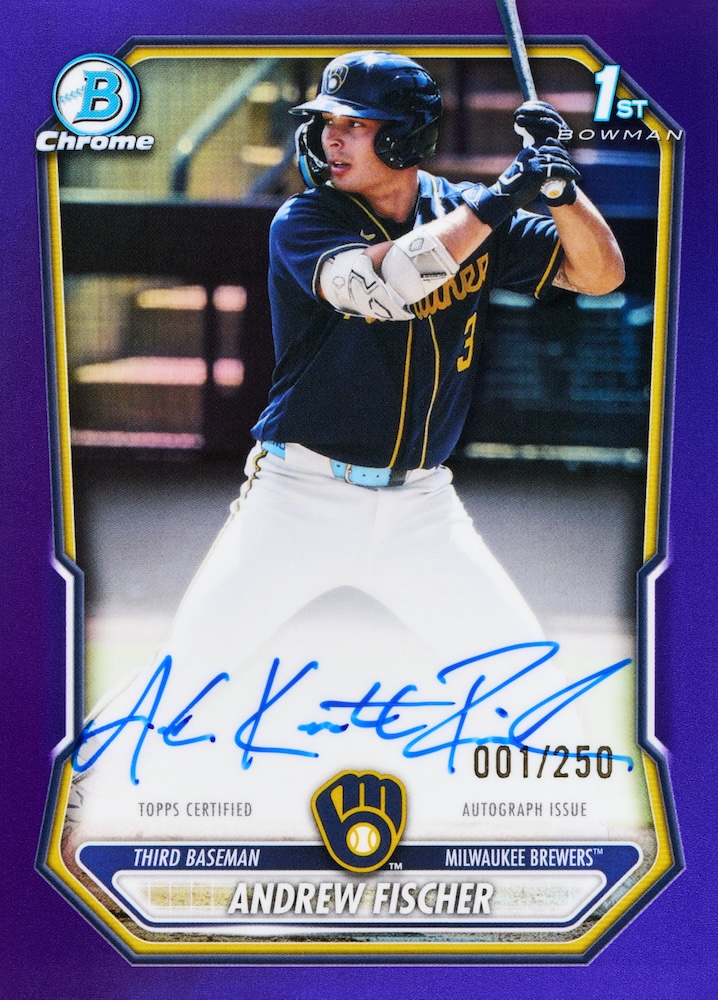
Beyond the Box Scores: Using Exit Velocity to Evaluate Bowman Prospects
Box scores tell you what happened in games. They don't always tell you who the player is. The collectors who do well in this market are the ones who can read past a small sample slash line and figure out whether the bat is performing above the box score.
Why Exit Velocity Matters
Average exit velocity measures how hard a hitter is consistently squaring up the ball, regardless of where it lands. The defense, the park, the BABIP variance, none of it changes the number. A hitter posting a 95 mph average EV is hitting the ball harder than all their peers. Aaron Judge has led the league around 95 MPH and is currently at 92 MPH so far in 2026.
Two metrics ride alongside avg EV and matter just as much:
- Hard-Hit % is the share of batted balls at 95+ mph. League average is around 35%. Anything north of 45% is plus, 50%+ is elite.
- Barrel % is the EV-and-launch-angle combo that defines optimal contact. 8% is good, 12%+ is rare, 15%+ is very rare.
A bat with high EV, high hard-hit, and high barrel is producing the inputs of a great offensive line. The question is just whether the surface stats catch up. Sometimes it takes a season. Occasionally it never happens, because the strikeouts swamp the contact quality.
A few caveats before the names. Sample size matters. I want at least 30 batted balls before I trust the data, and 50+ before I'd really be interested. Hard contact still has to find a useful angle. Bullets at the second baseman aren't hits. Watch the sweet spot rate (launch angle 8-32 degrees) alongside the EV. The strikeout rate has to come down for the bat to play. Hard contact but a 30% K rate in the minors is probably not going to play at higher levels.
Three names where the contact data is currently disconnected from the surface line.
Kemp Alderman // RF, Miami Marlins
The loudest exit velocity in the entire prospect pool I have data on, sitting on a $21 base auto.
Alderman is hitting .231/.341/.410 at AAA Jacksonville with a 35% strikeout rate. On the surface that reads as a fringe AAA hitter. The contact data tells a different story. His average exit velocity is 96.8 mph, which puts him in the same neighborhood as the MLB-wide leaders. His hard-hit rate is 63%. His barrel rate is 13%. The max EV is 114.6 mph. Across 46 batted balls, almost everything he hits is hard.
The bear case is the strikeouts. They're real, they were real in college, and they're the reason this is a $20 card and not a $60 card. But the rare combination is loud contact plus power tools plus an OBP above .340. If the swing-and-miss tightens up, even slightly, this is the profile of a major-league corner bat.
Bowman 1st Auto: 2023 Bowman Draft (CDA-KA). Raw base auto at $21, PSA 10 at $94. My ownership: A few raw cards. The 4.5x raw-to-graded multiplier is tighter than I'd want for sending base autos in to grade, but I'm holding what I have. At $20 the entry is fair given the contact ceiling.
Quentin Young // SS, Minnesota Twins
Boom-or-bust 19-year-old with a 19% barrel rate and a 49% strikeout rate. Pick a side.
The Twins took him 54th overall in the 2025 draft out of Oaks Christian, signed him for $1.76M, and got a 6'5", 215-pound 19-year-old whose pre-draft tools graded 40 hit / 60 power / 55 run / 50 field / 70 arm. The physical profile, the bloodlines (nephew of Dmitri and Delmon), and the bat speed are why he went where he did. The hit tool was always the question.
Through 18 games at Low-A he's slashing .164/.247/.284 with 38 strikeouts in 77 plate appearances. That part is exactly what scouts warned about. The contact, when he gets to it, is genuinely loud: 93 mph average EV, 19.4% barrel rate, 54.8% hard-hit, 110 mph max. That barrel rate is a number almost nobody his age posts. He hit his first pro homer on April 7. The bat speed and raw power are showing up in the data even when the at-bats are not.
This is a small-position dart. Worst case the hit tool never plays and the cards drift. Best case he tightens the contact rate even modestly, and Young becomes a big time power bat worth watching.
Bowman 1st Auto: 2025 Bowman Draft (CPA-QY). Raw base auto at $20, PSA 10 at $79. My ownership: Zero today. Worth a small starter at $10, will probably grab one base auto and check back in three months.
Bryce Rainer // SS, Detroit Tigers
Top 30 ranked prospect with elite Low-A contact data and a price that's gotten ahead of the production.
Rainer went 11th overall in the 2024 draft out of Harvard-Westlake for $5.8M, missed a chunk of 2025 with a dislocated shoulder that needed surgery, and is now back at Low-A West Michigan posting 93.7 mph average EV, 17.4% barrel rate, 116.2 mph max EV, 43.5% hard-hit. He homered 477 feet at 116 mph on April 10. He got promoted to High-A on April 20. The contact data is consistent with a top-30 prospect, which is what he is.
The surface .167/.265/.310 line at Low-A is hiding a hitter who is one of the loudest 20-year-olds in the minors. Baseball America has floated him as a candidate for the No. 1 overall prospect ranking entering 2027. The org promoting him after 11 games at Low-A signals they see the same thing.
Where I get off the train is the price. The 1st Bowman base auto is $126 and the PSA 10 sits at $365. That is a real position to take on a guy with 50 plate appearances of 2026 data, a recent surgery, and a hot start that hasn't shown up in the slash line yet. At $126, even with the data, I'm out. If the price comes back to the $60s at any point, this is a different conversation. Today it's not.
Bowman 1st Auto: 2024 Bowman Draft (CPA-BR). Raw base auto at $126, PSA 10 at $365. My ownership: Zero. Watching for a price reset.
How I Use This Lens
Four rules for myself when the contact data and the surface line are pointing different directions.
Sample size is non-negotiable. I want 30+ batted balls of tracked data before I trust EV, and 50+ before I'd size up a buy on it. Anything under that is a coin flip.
Hard contact at the wrong angle is just hard outs. A 100 mph ground ball at the second baseman is not a hit. Watch the sweet spot rate (launch angle between 8 and 32 degrees) alongside the EV. A guy with high EV and a low sweet spot rate is hitting bullets into the dirt. Less actionable than the same EV with a higher sweet-spot rate.
The strikeout rate has to come down for the contact to play. Both Alderman and Young have whiff problems. The contact data says they have a chance to be impact bats, but only if the K rate stops being a 35-50% drag on the surface line. That's the part I'm watching for through May and June.
Price matters as much as the data. Rainer has the best underlying contact numbers of the three relative to his level. His card is the worst buy. The point of looking at exit velocity is to find what the market hasn't priced in yet. When the market has already priced the underlying (a top 30 ranking, a $125 card), the data is interesting but not actionable.
I'll revisit these three at the end of May.
This is not financial advice. These are cards. The data and analysis are here to inform. You make your own calls.
This article was generated with the assistance of AI and reviewed before publishing. Always verify latest market data, stats, or news.
Published: April 2026