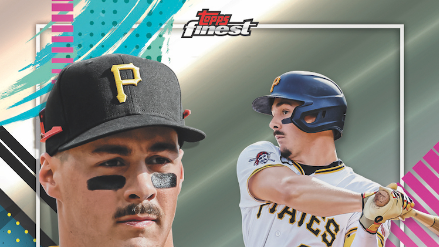
2026 Topps Finest Baseball: The Complete Odds, Parallel, and Print Run Breakdown
Four formats, a brand-new Super Rare tier, the first retail Mega in Finest history, and enough serial numbering to back into the print runs. Here's the full breakdown.
Finest is one of my favorite rips of the year, and 2026 is the biggest structural shake-up the product has seen in a long time. There's a new base tier, the first retail Mega Box in Finest history, a premium First Day Issue release that sold through a Dutch auction, and a Breaker-only format with its own exclusive rainbow.
I pulled the full odds sheet and the numbered checklist and worked through all of it. Here's everything I've got on the four formats, the parallels, the odds, and my best math on print runs and total production.
What's new in 2026
The headline is the base set. Finest expands to 350 cards across four tiers: Common (1 to 100), Uncommon (101 to 200), Rare (201 to 300), and the brand-new Super Rare tier (301 to 350, 50 cards). Super Rare is a Hobby-driven chase with a much shorter parallel rainbow, and it's the toughest base pull in the product.
The other big change is retail. For the first time in Finest history there's a Mega Box, and it carries an exclusive rainbow, the Mini Diamond, that you can't find anywhere else. Alongside it, Topps ran a limited First Day Issue release and a Breaker Delight format, each with their own exclusive parallels.
New inserts this year: Aura and Nightmare Fuel as SSP chases, plus the debut of Finest Forces and Finest Futures, which live only in Mega Boxes. Finest Ink is new too, built around players known for a standout signature.
The four formats
Hobby. Two guaranteed autos per box, 60 cards across six 10-card packs, eight boxes per case, presales around $339.99. Hobby is the only place to find the X-Fractor rainbow and the Super Rare base tier. This is the format built for the auto and rainbow chaser.
First Day Issue (FDI). The premium tier. It opened at $1,200 a box and sold out at $800 through a Dutch auction. FDI shares Hobby's 10-card, six-pack setup but carries the FDI-exclusive Molten Mercury Refractor, numbered to /11. It's a genuinely tiny release, and that matters a lot once you get to print runs.
Breaker Delight. A breaker-focused format holding the exclusive Geometric Refractor rainbow and the Breaker-only Finest Phenoms insert, a design pulled from the 1996 Finest checklist. Small production, heavy on low-numbered parallels per pack.
Mega Box. The first retail Finest ever, at $69.99. Megas carry the exclusive Mini Diamond rainbow plus two Mega-only insert lines, Finest Forces and Finest Futures, and a Mega-exclusive Finest Mega Autographs set. Six cards per pack, eight packs per box, 20 boxes per case.
The parallel rainbows
The core numbered Refractor rainbow runs the same ladder across the product:
Yellow /275, Pink /250, Aqua /199, Blue /150, Green /99, Purple /75, Gold /50, White /30, Orange /25, Black /10, Red /5, and the one-of-one SuperFractor. FDI adds Molten Mercury /11 to that ladder.
On top of the standard rainbow, each format layers its own look:
- Hobby: the X-Fractor rainbow (Green /99 down through Red, plus a SuperFractor)
- Breaker: the Geometric Refractor rainbow (Purple, Gold, Orange, Black, Red, and Tie-Dye)
- Mega: the Mini Diamond rainbow, on the same /N ladder as the base Refractors
There's also an unnumbered Oil Spill Refractor in Hobby and FDI, plus White, Pink, and Aqua Refractors that round out the base rainbow.
Odds highlights
A few things worth knowing before you buy:
- Base Refractors are easy in every format. In Mega they fall 1:9 packs, in Hobby 1:3.
- The numbered colors get long fast. A base Gold /50 runs roughly 1:152 in Hobby and 1:1,083 in Mega. Red /5 is about 1:1,511 Hobby and 1:14,468 Mega.
- Megas trade auto frequency for one rich exclusive. The shared auto lines run 50 to 65 times longer per pack in Mega than in Hobby, but the Mega-exclusive Finest Mega Autographs hit at 1:67 packs, about one every eight boxes.
- Counting every auto line and its parallels together, a Mega Box lands roughly one auto every three boxes. Hobby guarantees two per box.
My print run estimates
This is the part I find most interesting. The odds sheet alone won't give you print runs, but once you pair the serial numbering with the odds, the math opens up. For any parallel numbered /N across a set of S subjects, there are S times N copies in existence. If that card is exclusive to one format and falls 1:X packs, that format printed S times N times X packs. The format-exclusive numbered cards let me isolate each channel cleanly.
Here's where I land:
| Format | Estimated boxes | Share of print run | Confidence |
|---|---|---|---|
| Mega | ~257,000 (~12,900 cases) | ~76% | High |
| Hobby | ~67,700 (~8,500 cases) | ~20% | High |
| Breaker | ~11,000 | ~3% | Medium |
| FDI | ~1,100 | under 1% | Medium |
| Total | ~337,000 boxes |
The Mega figure is the strongest. It's cross-validated by nearly 30 separate anchors, the full base Mini Diamond rainbow plus the SuperFractors in Finest Forces, Finest Futures, and Finest Mega Autographs, and they all cluster in a tight 250,000 to 260,000 box band. Hobby is pinned three different ways off the Super Rare parallels and agrees to within about one percent. Breaker comes from the Breaker-exclusive Finest Phenoms. FDI comes from Molten Mercury, and the numbers self-check to almost exactly 100 subjects per base tier, which gives me confidence in a very small print run there.
One honest caveat: the base-common SuperFractor is the only card on the sheet whose stated Mega odds won't reconcile with everything else. Its number implies more one-of-ones than can exist, so I excluded it as a likely misprint in the odds rather than let it skew the estimate.
Total production
Putting cards per pack against those pack counts, I estimate roughly 16.5 million total cards produced across the product. Mega Boxes account for about 12.4 million of them, close to three quarters of everything printed. Hobby adds around 4.1 million, and Breaker and FDI together are a rounding error against that. The short version: five of every six Finest cards this year came out of a Mega Box.
Derived print runs
Here is the payoff from pairing those box counts with the odds sheet. Once you know how many boxes each format printed, every pull rate on the sheet converts into an actual copy count, even for the parallels that carry no serial number. These are the figures that tell you what a card's rarity really is, not the "common" label on the wrapper.
| Card | Total copies | Subjects | Per-card |
|---|---|---|---|
| Base Common* | ~2,200,000 | 100 | ~22,000 |
| Base Uncommon | ~1,440,000 | 100 | ~14,400 |
| Base Rare | ~480,000 | 100 | ~4,800 |
| Base Super Rare | ~7,500 | 50 | ~150 |
| Base Refractor (per tier) | ~372,000 | — | — |
| Base Oil Spill Refractor (per tier) | ~3,150 | — | — |
| Arrivals | ~431,000 | — | — |
| Topps Team Finest | ~395,000 | — | — |
| Worlds Finest | ~480,000 | — | — |
| Finest Timelines | ~206,000 | — | — |
| Gusto | ~3,500 | — | — |
| Smashing Through | ~3,500 | — | — |
| The Man | ~1,750 | — | — |
| Nightmare Fuel | ~1,000 | — | — |
| Headliners | ~750 | — | — |
| Aura | ~500 | — | — |
| Finest Forces | ~8,600 | 25 | ~343 |
| Finest Futures | ~8,600 | 25 | ~343 |
| Finest Phenoms | ~11,000 | 25 | ~440 |
*Base Common is the pack filler, not in the odds sheet, so ~22,000 per card is a rough structural estimate, not a derived one. The dash rows need set sizes to convert total to per-card. Mega-heavy lines (base tiers, the common inserts) carry the Mega print uncertainty; the scarce Hobby-driven chase cards (Aura through The Man) are firm.
Players to watch
Quick note on how to think about card counts. Every player in a given base tier shares the same Refractor rainbow, so what separates one subject's footprint from another is how many insert sets they land in and whether they have autos. Crossover stars pile up cards through insert appearances. Top rookies pile them up through autographs.
Veterans. The biggest names, Shohei Ohtani, Aaron Judge, and Bobby Witt Jr., are the ones you'll see spread across the marquee inserts like The Man, Headliners, Worlds Finest, Aura, and Topps Team Finest, each with a full numbered rainbow. That insert crossover, not autos, is what drives their totals, since the true superstar autos are scarce and often redemption-driven. Paul Skenes sits in the same conversation as a sophomore anchor and gets featured heavily on the base design.
Rookies. This is one of the strongest rookie classes in recent memory, and the top names carry the highest total card counts in the whole product. They hit base, rookie inserts like Arrivals and the Mega-only Finest Forces and Finest Futures, and multiple auto sets: Finest Autographs, Rookie Patch Autographs, and the Rookie Cup lines. Roman Anthony and Konnor Griffin are the headliners, with JJ Wetherholt and Kevin McGonigle right behind. Jac Caglianone, Jacob Misiorowski, Munetaka Murakami, Sal Stewart, and Justin Crawford round out a deep group that'll drive a lot of the auto chase.
The structural read is clear: the marquee rookies with both rookie-insert and multi-auto treatment top the count, and Ohtani, Judge, and Witt lead the veteran side on insert volume alone.
The bottom line
2026 Finest is a product with a very wide spread. Megas are cheap, everywhere, and carry a genuinely fun exclusive in the Mini Diamond rainbow plus that accessible 1:67 Mega Auto, but they give up X-Fractors, Oil Spill, Super Rare, and the Finest Moments autos. Hobby is where the guaranteed autos, the full rainbow, and the Super Rare chase live. FDI and Breaker are small, premium, parallel-rich formats for collectors chasing a specific look.
Whatever you rip, know what each format can and can't deliver before you buy, and let the print runs tell you how rare your hit really is.
Track upcoming drops on the HobbyMonitor Release Calendar.
This is not financial advice. These are cards. The data and analysis are here to inform. You make your own calls.
This article was generated with the assistance of AI and reviewed before publishing. Always verify latest market data, stats, or news.
Published: July 2026