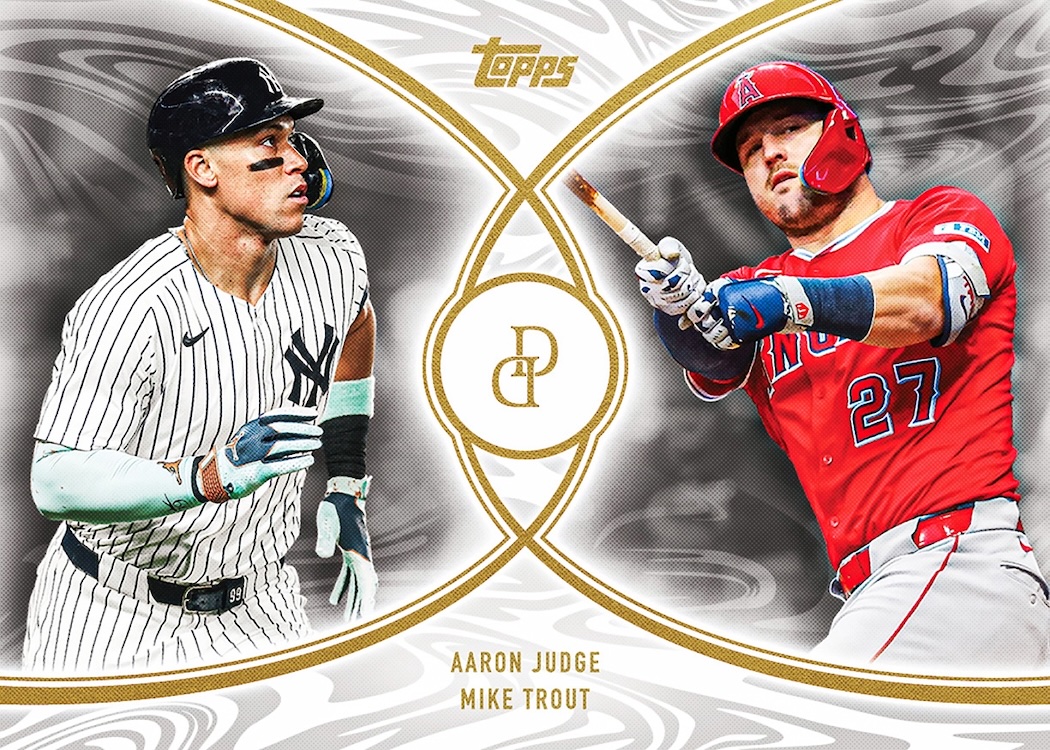
2026 Topps Dynamic Duals Baseball: The Complete Odds, Parallel, and Print Run Breakdown
Dynamic Duals is a small, focused product built around a single idea: two players on one card. I pulled the odds sheet and the checklist and worked through both, and this one turned out to be unusually clean to model. Single format, one odds column, and a parallel ladder that reconciles across every subset in the product. Here is the full breakdown, including the numbering Topps did not publish.
What this product is
Fifty base cards, each pairing two players. Some pairings are current teammates like Soto and Lindor or Ohtani and Betts. Some are era bridges like Sammy Sosa with Pete Crow-Armstrong or Elly De La Cruz with Barry Larkin. Five more base cards sit on top as short prints, and those five are all legend pairings: Robinson and Clemente, Aaron and Ruth, Mays and Mantle, Williams and DiMaggio, Banks and Gibson.
Three inserts round it out. Fence Busters and Future Forward at five cards each, Youth Impact at ten. There is a five-card Dynamic "Duels" super short print tier, a dual autograph parallel of the full fifty-card base, and one twelve-signature booklet sitting at the top of the product.
The base set is 50, not 55
The checklist reads as 55 base cards, but it is really 50 plus 5. Cards 51 through 55 are the short print tier, and two things confirm it. The dual autograph checklist runs 1-A through 50-A and stops, and the base and short print parallel odds scale at almost exactly ten to one, which is the 50 to 5 set size ratio. If you are building a master set, treat the legends as a separate chase.
The parallel ladder
Topps did not publish serial numbering on the odds sheet, so I derived it. Normalizing every parallel to a per-card pull rate produces the same ratio series across base, short prints, Fence Busters, Future Forward, and Youth Impact: 1 to 0.50 to 0.25 to 0.10 to 0.05 to 0.01. That maps onto a standard Topps ladder with very little ambiguity.
| Parallel | Implied count | Numbering |
|---|---|---|
| Rainbow | 99 | /99 |
| Black | 49 | /50 |
| Blue | 25 | /25 |
| Red | 10 | /10 |
| Orange | 5 | /5 |
| Gold | 1 | /1 |
This is a compressed ladder, not the flagship one. There is no /999 or /250 anywhere in this product, and the top of the rainbow is a Gold one-of-one rather than a SuperFractor. That matters, because the odds sheet on its own cannot tell you which ladder you are looking at. The ratios between tiers are identical whether the top is /99 or /999. What pins it down is the Gold, which reconciles to exactly 1.0 copy per card. A one-of-one landing on 1.0 is the cleanest validator this method has, and it fixes the scale of the entire product.
Base carries the full six-tier ladder. The three inserts and the short prints carry Black, Red, Orange, and Gold only, so there is no Rainbow or Blue on the insert side.
The autograph rainbow uses a different and looser structure, covered below.
Odds highlights
- Base Rainbow is the entry point at 1:6, and the short print tier falls 1:5. Both are essentially one per box on a five-pack configuration.
- The base ladder gets long fast. Black is 1:12, Blue 1:24, Red 1:59, Orange 1:118, and Gold 1:588.
- Insert parallels are much thinner than their base counterparts because the sets are so small. A Fence Busters Gold is 1:6,281.
- Dual autographs land at roughly one per five packs when you sum every parallel tier. That is the most striking number on the sheet.
- The Dynamic "Dozen" Autograph Booklet is 1:18,845, the single hardest pull in the product by a wide margin.
My print run estimate
Solving the whole system by weighted least squares across all twenty-four numbered constraints lands on roughly 29,600 packs, at about 2.9 percent RMS error.
The two that miss are the 1:6,281 and 1:2,692 Gold tiers, off by 6 and 10 percent. Those are rounding artifacts of four-digit odds denominators, not a problem with the model. When Topps rounds 1:6,281 from something like 1:6,700, a ten-copy print run absorbs that error loudly.
Short prints fall exactly 1:5, and the dual autograph tiers sum to exactly one per five packs. That is a one-autograph-per-box, one-short-print-per-box build, and it puts this product at roughly 5,900 boxes and 590 cases.
That is a very small print run. For scale, 2026 Topps Chrome ran somewhere north of fifteen million packs. Dynamic Duals is running about two tenths of one percent of that.
The pack build reverse-engineers perfectly
Hobby is five cards per pack, five packs per box, ten boxes per case. Plugging that in produces the cleanest validation I have seen on one of these.
Sum every single line on the odds sheet, every parallel, every insert, every autograph tier, and the total comes to 0.9987 cards per pack. That is exactly one non-common card per pack, to within a tenth of a percent. Nothing in the math forced it to land on a whole number, and it did.
So the build is four base commons plus one hit slot per pack. A box is twenty base cards and five hits. That also means the five hits in a box break down, on average, to one short print, one dual autograph, one base parallel, one insert, and one of everything else, which is a remarkably tidy configuration.
With that anchored:
| Metric | Estimate |
|---|---|
| Packs | ~29,600 |
| Boxes | ~5,900 |
| Cases | ~590 |
| Total cards produced | ~148,000 |
| Base commons | ~118,400 |
| Copies per base card | ~2,370 |
One caveat on that pack-build check. The sum of the odds is a per-pack figure, so it confirms how a pack is assembled but tells you nothing about how many packs were made. The scale comes from the Gold one-of-one, not from this.
What the print runs say about scarcity
- The base is thin by any standard. A common base card runs about 2,370 copies. For comparison, a base Chrome common runs about 169,000. There is no deep filler layer in this product.
- The short prints are exactly half the base. Cards 51 through 55 come out around 1,184 copies each, a clean two to one against base. Scarce in absolute terms, but the most common of the legends pairings.
- The Dynamic "Duels" pairings are the most underrated cards in the product. Five cards, roughly 50 copies each, and no serial number anywhere on them. That makes them scarcer than the Black /50 base parallel while carrying none of the visual signaling that drives price. Ohtani and Judge, Skenes and De La Cruz, Acuña and Soto, Griffey and Trout, Caglianone and Anthony. If you are buying singles out of this product, start here.
- Youth Impact prints deepest. Ten cards at 1:9 works out to about 330 each, the most common insert in the product, and it is still a three-figure print run.
- Future Forward is the thinnest insert. Five cards at 1:30 gives roughly 197 each, against Fence Busters at about 296.
- The booklet is a true one-off. The odds solve to 1.6 copies, which realistically means one or two exist. Twelve signatures, and a lineup of Ohtani, Trout, Pujols, Ripken, Skenes, Acuña, Ichiro, Griffey, Soto, Jeter, Judge, and Betts. This is the card that defines the product, and it will almost certainly never appear in a sealed box on the secondary market given how much a booklet changes a box's weight.
The autographs are the whole product
Dual autographs cover all fifty base cards and total roughly 5,900 cards, which is exactly one per box. There is no unnumbered autograph tier, so every single autograph in this product is numbered, and every one of them has a print run under 100. That is unusual and it is the strongest thing the product has going for it.
The tier structure does something odd. Sorted by odds, Black is more common than Purple, and Purple is more common than Rainbow, which never happens in a correctly ordered ladder. Working from the base ladder, the autograph Rainbow should be /99 and Purple /75, but only about 24 and 30 copies per card actually reached packs. The likely explanations are that some signers skipped those tiers, or that copies were pulled back to cover redemption replacements. Both are common. Either way, the effective scarcity is inverted from what the numbering will tell you, and a Rainbow /99 auto out of this product is genuinely rarer than a Black /50.
The bottom of the ladder holds up cleanly. Red averages about 9 per card, Orange about 5, and Gold lands on exactly 1.0, which is the check that anchors the whole model.
Players to watch
Every base card shares the same rainbow, so what separates one card from another is who is on it and whether both players signed.
The marquee pairings. Card 6 is Ohtani and Betts, card 5 is Judge and Trout, card 53 is Mays and Mantle. Those three will carry the product. Card 49, Koufax and Ryan, is the sleeper on the legends side.
Rookies and young stars. Jac Caglianone with Bobby Witt Jr., Roman Anthony with Marcelo Mayer, Skenes with Misiorowski, and Nick Kurtz with Jacob Wilson all appear on base, dual autos, and at least one insert. Caglianone shows up on base, Youth Impact, and the Duels SSP tier, which gives him the widest footprint of any young player in the set.
Cross-era plays. Trey Yesavage with Vladimir Guerrero Jr., Colson Montgomery with Kyle Teel, and Dylan Crews with Larry Walker are the pairings I would watch if the rookies break out, since a dual auto on those becomes a very different card in a year.
The bottom line
Dynamic Duals is a narrow, autograph-forward product with a compressed ladder and a genuine hidden chase. At roughly 29,600 packs and 148,000 total cards it is one of the smallest print runs Topps has put out this year. The base and short print tiers are deep enough that they will not carry value on their own, so the entire product lives on the dual autographs and the five Dynamic "Duels" pairings. If you are buying with intent, buy for the SSPs and the star autos, and treat everything else as filler.
The full print run table
The numbered parallels are not listed individually because their per-card count equals their serial. A Gold /10 is ten copies, a Black /499 is 499, and so on. What follows are the unnumbered and derived figures where the print run is not obvious. Subset is the number of cards in that set, and per card is the estimated copies of each.
Base and short prints
| Card | Subset | Est. total | Per card |
|---|---|---|---|
| Base (common, #1-50) | 50 | 118,412 | 2,368 |
| Short Prints (#51-55) | 5 | 5,921 | 1,184 |
| Dynamic "Duels" SSP | 5 | 251 | 50 |
Inserts
| Card | Subset | Est. total | Per card |
|---|---|---|---|
| Youth Impact | 10 | 3,289 | 329 |
| Fence Busters | 5 | 1,480 | 296 |
| Future Forward | 5 | 987 | 197 |
Autographs
| Card | Subset | Est. total | Per card (avg) |
|---|---|---|---|
| Dual Auto Black (/50) | 50 | 1,558 | 31 |
| Dual Auto Purple (/75) | 50 | 1,480 | 30 |
| Dual Auto Rainbow (/99) | 50 | 1,184 | 24 |
| Dual Auto Blue | 50 | 955 | 19 |
| Dual Auto Red | 50 | 449 | 9 |
| Dual Auto Orange | 50 | 245 | 5 |
| Dual Auto Gold (/1) | 50 | 52 | 1 |
| Dynamic "Dozen" Auto Booklet | 1 | ~2 | ~2 |
Two caveats worth repeating. The parallel numbering is derived from the odds, not published. The ratios between tiers are solid, and the Gold one-of-one anchors the absolute scale, but if Topps publishes a ladder that contradicts it, every figure moves proportionally. And the autograph figures are what actually reached packs, not the stated serial numbering, which is why several tiers come in well under their number.
All figures are estimates built from the published odds and are subject to change if Topps revises the sheet.
See the full release schedule on the HobbyMonitor Release Calendar.
This is not financial advice. These are cards. The data and analysis are here to inform. You make your own calls.
This article was generated with the assistance of AI and reviewed before publishing. Always verify latest market data, stats, or news.
Published: July 2026