2026 Topps Chrome Tennis: The Complete Odds, Parallel, and Print Run Breakdown
2026 Topps Chrome Tennis released September 30, and Topps posted the odds sheet two days earlier. It runs 140 lines across three columns: Hobby, Breaker and Value. Like most sheets it lists odds and no print runs. What makes this one useful is that it adds up. Three lines that live in only one format give away how many packs of each the sheet is built on, and at those pack counts nearly every SuperFractor on the sheet comes back to one card per player, to within a fraction of a card. From there we can check every numbered parallel, estimate the cards that carry no number, and see where the autographs actually went.
The checklist
The base set is 200 cards, from Coco Gauff at #1 to Pete Sampras at #200. It mixes today's tours with legends like Andre Agassi, Steffi Graf, Maria Sharapova, Chris Evert, Martina Navratilova, Billie Jean King, Boris Becker and Ivan Lendl. There are 34 rookie cards, all in the first 100, including João Fonseca, Hannah Klugman, Mika Stojsavljevic and Nishesh Basavareddy. Topps' product page calls it a 300-card base set in one spot, but Topps' checklist and its Hobby box listing both say 200, and the odds are built on 200.
The inserts:
- World No. 1's, 25 players who held the top ranking, from Bjorn Borg and Chris Evert to Carlos Alcaraz and Aryna Sabalenka.
- Destiny, 30 cards.
- YouthQuake, 20 young players, including Fonseca, Learner Tien, Alexandra Eala and Victoria Mboko.
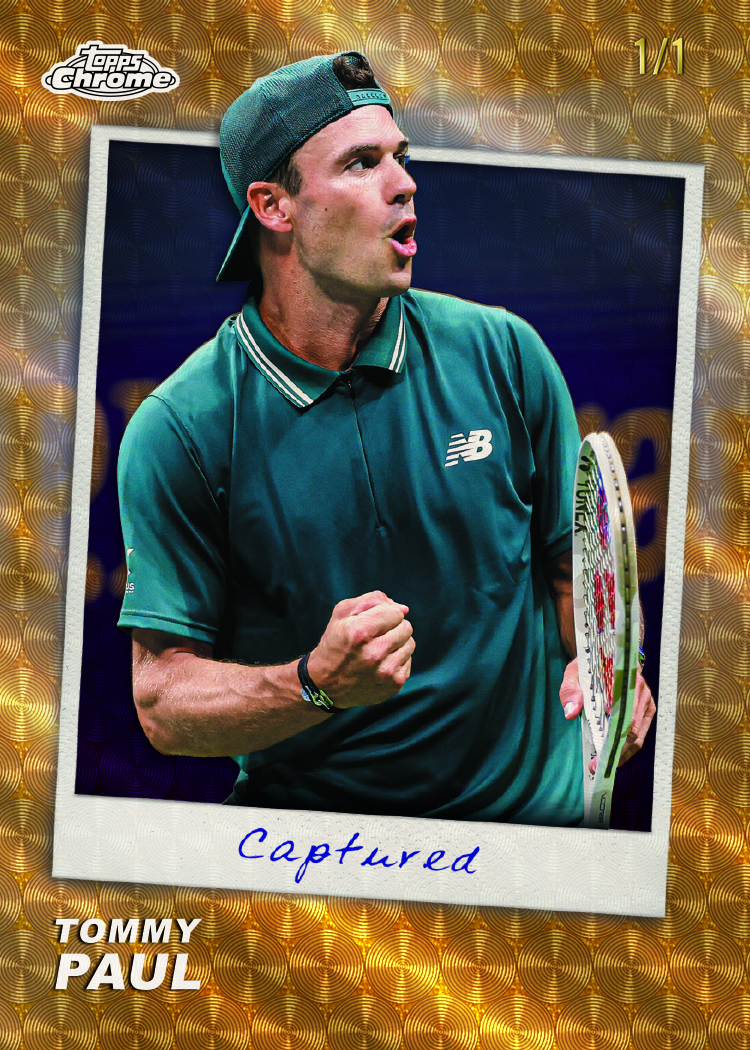
- Captured, 25 cards.
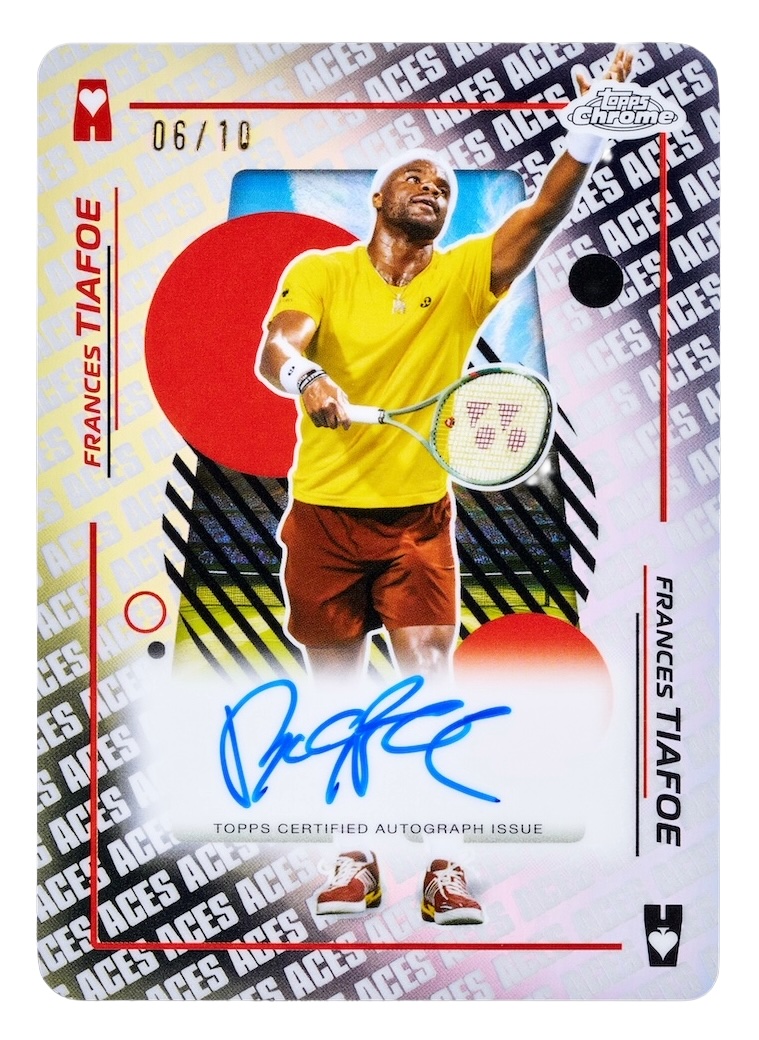
- Aces, 25 cards, far scarcer than the four above: 1:192 Hobby packs, about one every 16 boxes.
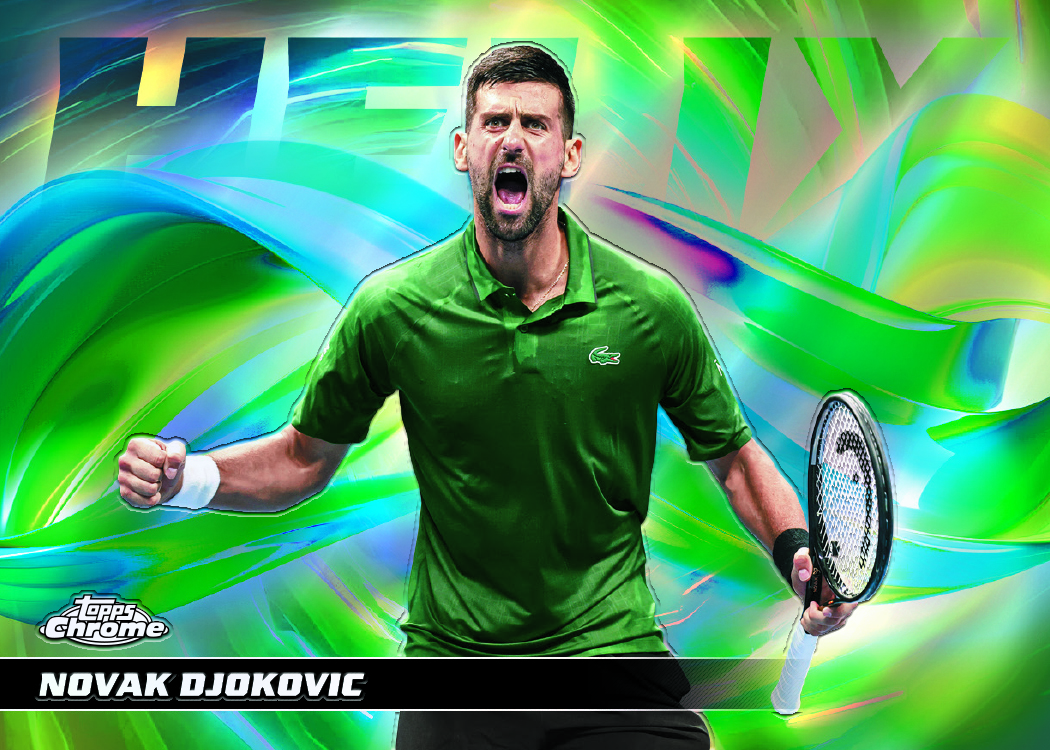
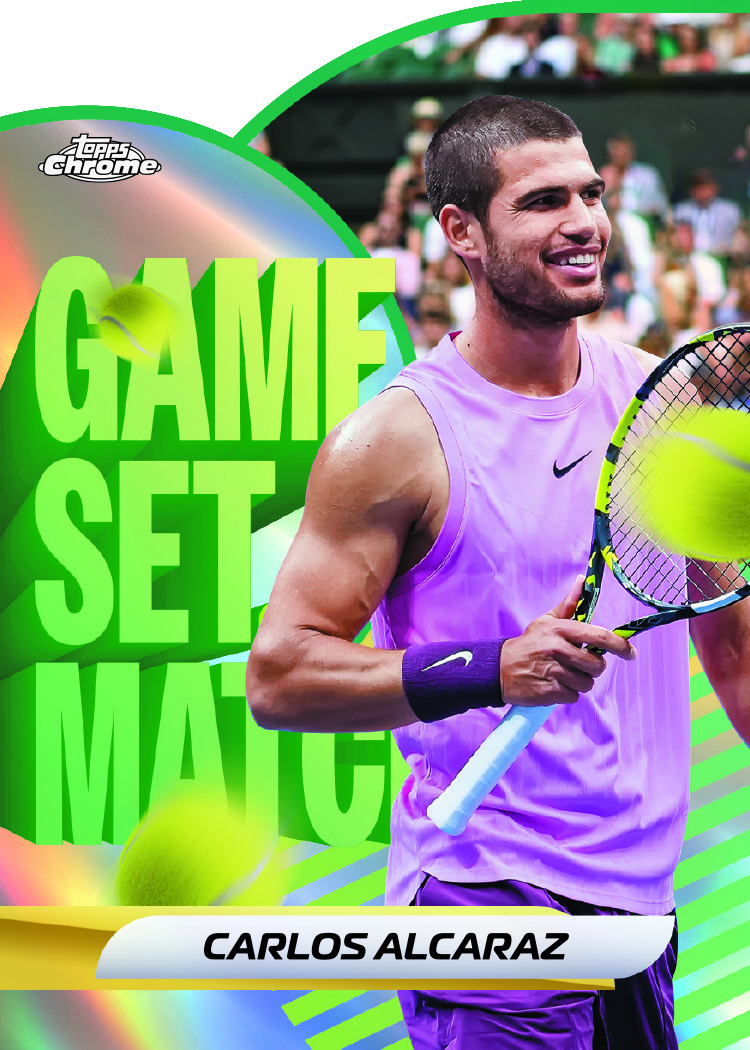
Topps calls three more case hits: Game. Set. Match. (25 cards), Solus (25) and Helix, just five cards: Sabalenka, Alcaraz, Gauff, Novak Djokovic and Rafael Nadal.
The autographs:
- Base Autographs I, 91 signers on Topps' current checklist. This is where the biggest names are: Alcaraz, Djokovic, Nadal, Sabalenka, Iga Swiatek and Gauff, plus Agassi, Graf, Sampras, John McEnroe, Navratilova, Evert and Sharapova. Fonseca, Lulu Sun and McCartney Kessler are the three rookies.
- Base Autographs II, 98 signers, deeper into both tours, with 30 of the set's rookie autographs.
- World Number 1 Autographs, 23 signers, the insert's list minus Garbiñe Muguruza and Venus Williams.
- Courtscripts Signatures, 20 signers, including Gauff, Ben Shelton, Elena Rybakina and Emma Raducanu.
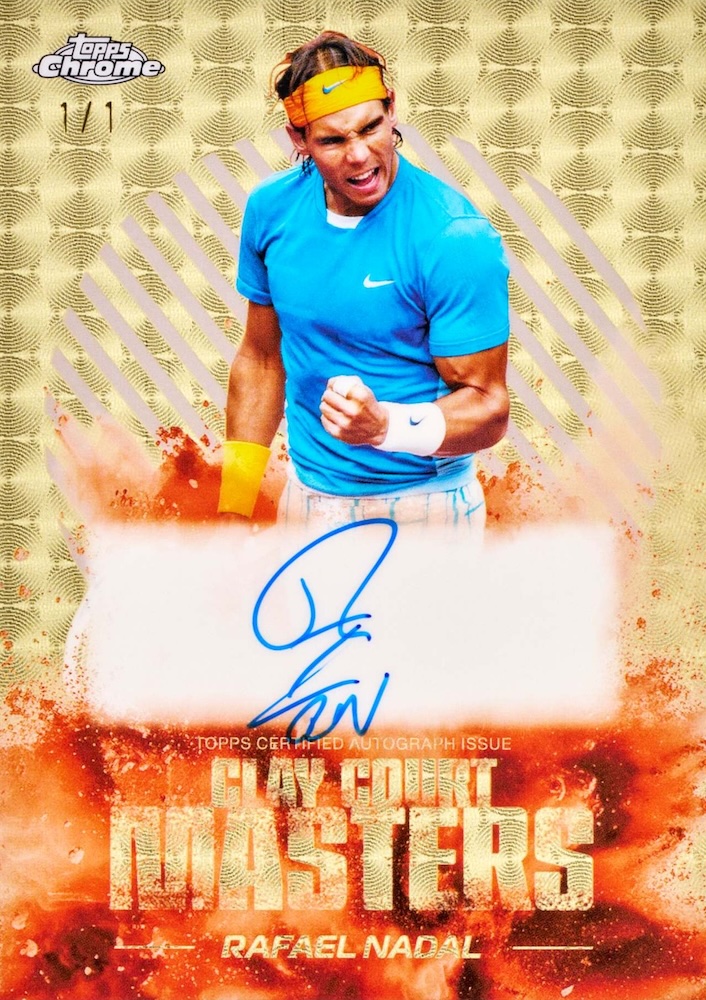
- Clay Court Masters, three signers: Alcaraz, Djokovic and Nadal.
- Dual Autographs, nine pairs, among them Taylor Fritz and Frances Tiafoe, Swiatek and Elina Svitolina, Madison Keys and Jessica Pegula, Fonseca and Beatriz Haddad Maia, and Clervie and Carel Ngounoue.
- Aces Autographs, 17 signers.
- YouthQuake Signatures, 18 signers.
That's 659 cards across 17 sets. Topps' checklist file also lists two short sets, Sapphire Infinite (15 cards) and Hidden Gems (5), that have no lines on this odds sheet. The separate Sapphire Edition is due October 28, and nothing below covers it.
The formats
- Hobby: 12 packs of 8 cards, two autographs per box. The sheet's autograph lines add up to 2.07 per box. The numbered lines add up to about 5.5 numbered cards per box. Hobby is the only place to find the Prism Refractor (1:3 packs, four a box), the Negative Refractor (1:6, two a box) and the FrozenFractors.
- Breaker: the Breaker box, which has its own column on the sheet. Topps' product page doesn't list it or its configuration. The sheet's Breaker column adds up to about 11 cards per pack, four to five of them autographs, and about six numbered cards. The Geometric Refractors live only here.
- Value Box: 7 packs of 4 cards. The RayWave Refractors and the Shimmer autographs are Value only. The sheet works out to about one autograph every three Value boxes and three numbered cards every five boxes.
Topps' own store lists both the Hobby and Value boxes as sold out.
The base rainbow
The colors that run in all three formats, with odds per pack:
| Parallel | Print run | Hobby | Breaker | Value |
|---|---|---|---|---|
| Refractor | Unnumbered | 1:1 | - | 1:7 |
| Yellow Refractor | /275 | 1:12 | 1:4 | 1:306 |
| Pink Refractor | /250 | 1:13 | 1:4 | 1:337 |
| Aqua Refractor | /199 | 1:16 | 1:5 | 1:423 |
| Blue Refractor | /150 | 1:21 | 1:7 | 1:561 |
| Green Refractor | /99 | 1:32 | 1:10 | 1:850 |
| Purple Refractor | /75 | 1:42 | 1:13 | 1:1,122 |
| Gold Refractor | /50 | 1:63 | 1:19 | 1:1,683 |
| Orange Refractor | /25 | 1:126 | 1:38 | 1:3,366 |
| Black Refractor | /10 | 1:315 | 1:93 | 1:8,414 |
| Red Refractor | /5 | 1:630 | 1:186 | 1:16,828 |
| SuperFractor | 1/1 | 1:3,148 | 1:927 | 1:84,140 |
In Hobby that's a base Red /5 about once every 52 boxes and a base SuperFractor about once every 262.
Each format also gets a ladder of its own:
| Color | Print run | Geometric (Breaker) | RayWave (Value) |
|---|---|---|---|
| Unnumbered version | - | 2 per pack | 1:3 |
| Aqua | /199 | 1:1 | - |
| Blue | /150 | 1:2 | - |
| Green | /99 | 1:2 | 1:43 |
| Purple | /75 | 1:3 | 1:57 |
| Gold | /50 | 1:4 | 1:85 |
| Orange | /25 | 1:8 | 1:169 |
| Black | /10 | 1:19 | 1:421 |
| Red | /5 | 1:37 | - |
Plus the Hobby-only FrozenFractors at 1:476 packs, about one every 40 Hobby boxes. There are five of each base card, and Topps' sheet lists them as numbered -5, -4, -3, -2 and -1.
The sheet prints no serial numbers. The print runs here are the ones in our data, and the odds back them. Add up the three formats and every tier from the Purple /75 down comes to 99 percent or more of its print run, and the SuperFractor comes to 200. The most common tiers drift lower, down to about 93 percent for the Yellow /275, because Topps rounds odds up to the next whole pack, and that costs the most on small odds: the Yellow's Breaker line works out to about 1 in 3.4 but prints as 1:4.
Counting every ladder, each base card has 2,016 numbered parallels: 1,139 in the main colors, 613 Geometric, 259 RayWave and five FrozenFractors.
The inserts
The four regular inserts run in Hobby and Value. Odds per pack, Hobby / Value:
| Insert | Cards | Base | Blue /150 | Gold /50 | Orange /25 | Red /5 | SuperFractor |
|---|---|---|---|---|---|---|---|
| World No. 1's | 25 | 1:4 / 1:14 | 1:150 / 1:1,496 | 1:448 / 1:4,488 | 1:895 / 1:8,975 | 1:4,473 / 1:44,875 | 1:22,363 / 1:224,374 |
| Captured | 25 | 1:4 / 1:14 | 1:150 / 1:1,496 | 1:448 / 1:4,488 | 1:895 / 1:8,975 | 1:4,473 / 1:44,875 | 1:22,363 / 1:224,374 |
| Destiny | 30 | 1:4 / 1:12 | 1:125 / 1:1,247 | 1:373 / 1:3,740 | 1:746 / 1:7,480 | 1:3,728 / 1:37,396 | 1:18,636 / 1:186,978 |
| YouthQuake | 20 | 1:5 / 1:17 | 1:187 / 1:1,870 | 1:560 / 1:5,610 | 1:1,119 / 1:11,219 | 1:5,591 / 1:56,094 | 1:27,953 / 1:280,467 |
Breaker gets Geometric versions of the same four instead:
| Insert | Geometric | Gold /50 | Orange /25 | Black /10 | Red /5 |
|---|---|---|---|---|---|
| World No. 1's, Captured (each) | 1:7 | 1:29 | 1:58 | 1:145 | 1:290 |
| Destiny | 1:6 | 1:25 | 1:49 | 1:121 | 1:241 |
| YouthQuake | 1:8 | 1:37 | 1:73 | 1:181 | 1:362 |
Aces and the three case hits run in all three formats, each with a SuperFractor:
| Insert | Cards | Hobby | Breaker | Value | SuperFractor (Hobby / Breaker / Value) |
|---|---|---|---|---|---|
| Aces | 25 | 1:192 | 1:9 | 1:1,122 | 1:57,600 / 1:2,494 / 1:373,956 |
| Solus | 25 | 1:768 | 1:34 | 1:4,987 | 1:57,600 / 1:2,494 / 1:373,956 |
| Game. Set. Match. | 25 | 1:1,152 | 1:50 | 1:7,480 | 1:57,600 / 1:2,494 / 1:373,956 |
| Helix | 5 | 1:2,880 | 1:125 | 1:18,698 | 1:288,000 / 1:12,466 / 1:1,869,778 |
In Hobby that's an Aces card about once every 16 boxes, a Solus every 64, a Game. Set. Match. every 96 and a Helix every 240.
The autographs
The two base autograph sets, odds per pack:
| Tier | Print run | Autographs I Hobby | Breaker | Value | Autographs II Hobby | Breaker | Value |
|---|---|---|---|---|---|---|---|
| Base autograph | Unnumbered | 1:236 | 1:20 | 1:2,175 | 1:17 | 1:2 | 1:151 |
| Refractor | Unnumbered | 1:155 | 1:13 | 1:1,426 | 1:27 | 1:3 | 1:246 |
| Pink | /250 | - | - | - | 1:44 | 1:4 | 1:407 |
| Blue | /150 | - | - | - | 1:74 | 1:7 | 1:684 |
| Green | /99 | - | - | - | 1:108 | 1:9 | 1:997 |
| Gold | /50 | 1:227 | 1:19 | 1:2,096 | 1:216 | 1:18 | 1:1,996 |
| Orange | /25 | 1:446 | 1:37 | 1:4,121 | 1:424 | 1:35 | 1:3,915 |
| Black | /10 | 1:1,115 | 1:91 | 1:10,308 | 1:1,057 | 1:86 | 1:9,769 |
| Red | /5 | 1:2,228 | 1:181 | 1:20,593 | 1:2,107 | 1:172 | 1:19,477 |
| SuperFractor | 1/1 | 1:11,111 | 1:903 | 1:102,736 | 1:10,643 | 1:865 | 1:98,410 |
Breaker adds a Geometric autograph ladder: the unnumbered Geometric at 1:4 packs for Autographs I and 1:1 for Autographs II, then Blue /150 (1:4 and 1:3), Green /99 (1:5, 1:4), Gold /50 (1:9, 1:8), Orange /25 (1:17, 1:16), Black /10 (1:42, 1:38) and Red /5 (1:83, 1:76). Value adds a Shimmer (1:135 and 1:50) and a Lime Green Shimmer (1:501 and 1:357).
The insert autographs are Hobby and Breaker only. Odds per pack, Hobby / Breaker:
| Set | Cards | Base | Black /10 | Red /5 | SuperFractor |
|---|---|---|---|---|---|
| World Number 1 Autographs | 23 | 1:1,595 / 1:132 | 1:4,062 / 1:335 | 1:7,947 / 1:655 | 1:39,733 / 1:3,275 |
| Courtscripts Signatures | 20 | 1:1,828 / 1:151 | 1:4,570 / 1:377 | 1:9,139 / 1:754 | 1:45,693 / 1:3,766 |
| YouthQuake Signatures | 18 | 1:2,031 / 1:168 | 1:5,134 / 1:424 | 1:10,268 / 1:847 | 1:50,770 / 1:4,185 |
| Aces Autographs | 17 | 1:2,151 / 1:178 | 1:5,376 / 1:444 | 1:10,752 / 1:887 | 1:53,756 / 1:4,431 |
| Dual Autographs | 9 | 1:4,062 / 1:335 | 1:10,268 / 1:847 | 1:20,308 / 1:1,674 | 1:101,539 / 1:8,369 |
| Clay Court Masters | 3 | 1:12,185 / 1:1,005 | - | - | 1:304,616 / 1:25,105 |
In Hobby, the two autographs per box are mostly Base Autographs II. The sheet works out to about 1.8 of those per box, a Base Autographs I about once every four or five boxes, and an insert autograph (any of the six sets above) about once every 21 boxes.
How many packs the sheet covers
Three lines give it away, because each lives in a single format:
- The FrozenFractors are Hobby only, five of each of 200 cards, 1,000 in all, at 1:476 packs. That's just under 476,000 Hobby packs.
- The Black RayWave /10 is Value only, 2,000 cards at 1:421. That's just under 842,000 Value packs.
- The YouthQuake Red Geometric /5 is Breaker only, 100 cards at 1:362. That's just under 36,200 Breaker packs. The Destiny and Captured Red Geometrics say the same thing.
Those are ceilings. Topps rounds its odds up to the next whole pack (a card that falls 1 in 36.2 packs prints as 1:37), so the real counts sit just under them. Check the counts against the rest of the sheet and they hold. The base SuperFractor comes to 151 in Hobby, 39 in Breaker and 10 in Value, 200 in all. The World No. 1's, Captured, Destiny and YouthQuake SuperFractors come to 25, 25, 30 and 20. Every insert autograph SuperFractor comes to its number of signers. The Base Autographs I SuperFractor comes to 91, the count on Topps' current checklist, and the Clay Court Masters SuperFractor to 3. Read that way, the whole sheet settles on:
| Format | Configuration | Packs | Boxes |
|---|---|---|---|
| Hobby | 12 packs of 8 | about 475,000 | about 39,600 |
| Breaker | not posted | about 36,150 | - |
| Value Box | 7 packs of 4 | about 841,000 | about 120,000 |
| Total | about 1.35 million |
These are the counts the sheet is built on, not a production report, and they aren't exact to the pack. Some 1-of-1s even split across formats in fractions: the three Clay Court Masters SuperFractors work out to 1.6 in Hobby and 1.4 in Breaker.
Those shares show where the cards went:
| Cards | Hobby | Breaker | Value |
|---|---|---|---|
| Share of all packs | 35% | 2.7% | 62% |
| Base color Refractors, Yellow through SuperFractor | 75.5% | 19.5% | 5% |
| Regular insert colors (World No. 1's, Captured, Destiny, YouthQuake) | 85% | - | 15% |
| Base Autographs I and II, numbered tiers | 47% | 44% | 9% |
| Insert autographs | 52% | 48% | - |
| Aces, Solus, Game. Set. Match. and Helix SuperFractors | 33% | 58% | 9% |
Breaker is 2.7 percent of the packs and gets 44 to 58 percent of the autographs and case-hit SuperFractors. By the sheet's own numbers there are roughly 285,000 autographs in the product, about 160,000 of them in Breaker packs, 82,000 in Hobby and 43,000 in Value. Breaker's odds are small and Topps rounds them up, so that Breaker figure is a floor.
Value is the opposite. It's 62 percent of the packs and gets 5 percent of the base color ladder.
The unnumbered chases
The same pack counts estimate the cards with no serial number: packs divided by odds, added across the formats, divided by the number of cards in the set.
| Card | Formats | Cards | Est. copies per card |
|---|---|---|---|
| Base Autographs I Lime Green Shimmer | Value | 91 | about 18 |
| Base Autographs II Lime Green Shimmer | Value | 98 | about 24 |
| Insert autographs (all six sets) | Hobby, Breaker | 3 to 23 | about 25 |
| Base Autographs I | All three | 91 | about 46 |
| Game. Set. Match. | All three | 25 | about 50 |
| Base Autographs I Shimmer | Value | 91 | about 69 |
| Base Autographs I Refractor | All three | 91 | about 70 |
| Solus | All three | 25 | about 75 |
| Base Autographs I Geometric | Breaker | 91 | about 99 |
| Helix | All three | 5 | about 100 |
| Base Autographs II Shimmer | Value | 98 | about 170 |
| World No. 1's, Captured, Destiny, YouthQuake Geometric | Breaker | 20 to 30 | about 200 to 225 |
| Aces | All three | 25 | about 290 |
| Base Autographs II Refractor | All three | 98 | about 340 |
| Base Geometric Refractor | Breaker | 200 | about 360 |
| Base Autographs II Geometric | Breaker | 98 | about 370 |
| Negative Refractor | Hobby | 200 | about 400 |
| Base Autographs II | All three | 98 | about 530 |
| Prism Refractor | Hobby | 200 | about 790 |
| RayWave Refractor | Value | 200 | about 1,400 |
| Refractor | Hobby, Value | 200 | about 3,000 |
| Destiny | Hobby, Value | 30 | about 6,300 |
| World No. 1's, Captured, YouthQuake | Hobby, Value | 20 to 25 | about 7,200 |
| Base | Hobby, Value | 200 | about 24,500 |
The plain versions of the six insert autograph sets are scarcer than they look. Every one of them works out to about 25 copies per card, as scarce as an Orange /25, and the sheet lists no print run for them. Clay Court Masters comes to about 75 cards in all, or 25 per player if Topps split them evenly.
The unnumbered Base Autographs I card is the other one to know. At about 46 copies per signer, it's scarcer than the Gold /50 version of the same card. The Value-only Lime Green Shimmers sit lower still, about 18 per Autographs I signer and 24 per Autographs II signer.
Solus, Game. Set. Match. and Helix land on about 75, 50 and 100 copies per card, which looks like what Topps was aiming for. The lines with small odds (Base Autographs II, Aces, the Geometrics, the Prism, Negative and RayWave Refractors and the 1:3 to 1:17 inserts) rest on odds Topps rounds up, so those figures are floors: a 1:3 line can mean anything between 1 in 2 and 1 in 3, and the real counts can be well higher.
Where the numbers get uneven
Topps notes on the sheet that a player being in a set doesn't guarantee a card in every parallel, and the odds show where that happens:
- Base Autographs II: the Red /5, Black /10 and SuperFractor each come to about 95 or 96 signers' worth of the 98. The Pink /250 and Blue /150 come to about 91 or 92, judging by their Value odds, the least rounded of the three.
- Base Autographs I Blue Geometric /150: at 1:4 Breaker packs it covers between about 60 and 80 of the 91 signers. A full run would print as 1:3. The Black /10 and Red /5 Geometrics come to about 87 or 88 signers' worth.
A few things on the sheet itself are off. Every page is headed "2026 Topps Chrome Tennis Sapphire," though the sheet is plainly this release and has no Sapphire parallels. The Prism and Negative Refractor lines read 1:0 in the Value column, which we read as blank. Both are Hobby only.
The rarest pulls
The longest Hobby line on the sheet is the Clay Court Masters SuperFractor at 1:304,616 packs, about one in every 25,400 Hobby boxes. There are three of them in the whole product, one each of Alcaraz, Djokovic and Nadal, split between Hobby and Breaker. Next is the Helix SuperFractor at 1:288,000 Hobby packs, five cards in all. Its Value line, 1:1,869,778 packs, is more than twice the number of Value packs made, so there's at most one in Value and possibly none.
Among the rest, the Dual Autographs SuperFractor falls 1:101,539 Hobby packs, nine cards, about one in every 8,500 Hobby boxes. In Breaker the rarest line is the same Clay Court Masters SuperFractor, at 1:25,105 packs. The base SuperFractor is 1:3,148 Hobby packs, 1:927 Breaker packs and 1:84,140 Value packs, about one in every 12,000 Value boxes.
What to watch
The things we're watching: whether the plain insert autographs turn up with a serial number, since the odds put them at 25 per signer; the same for the Lime Green Shimmers; the Base Autographs I Blue Geometric; Topps posting the Breaker box configuration; and the Sapphire Edition on October 28. We'll update this piece if any of that changes.
The full checklist and every parallel with its print run and odds are on the 2026 Topps Chrome Tennis release page, and you can track what you pull in HobbyMonitor Collections.
This is not financial advice. These are cards. The data and analysis are here to inform. You make your own calls.
This article was generated with the assistance of AI and reviewed before publishing. Always verify latest market data, stats, or news.
Published: September 2026