2026 Topps Chrome Logofractor Baseball: The Complete Odds, Parallel, and Print Run Breakdown
2026 Topps Chrome Logofractor Baseball released August 19. Topps' checklist file is dated August 17 and the odds sheet August 25. The sheet runs 66 lines in a single column, with odds per pack and no print runs, and it covers only the LogoFractor cards, reported at two of the five cards in a pack. Five Rose Gold lines put the run at about 672,000 packs, the count the odds are worked out on: 112,000 boxes and about 3.4 million cards. That's 5,600 cases at the reported 20 boxes a case, and about 1.3 million LogoFractors at two a pack. From there the sheet fits the print runs in our data on every base and insert ladder and puts a count on every card with no print run. It also turns up one ladder that doesn't fill. Most Rookie Autographs tiers run about 80 to 90 percent of their printed totals, the Rose Gold odds cover 40 of the 45 signers, and the Blue, /150 in our data, reads a pack rarer than the Green /99.
The box
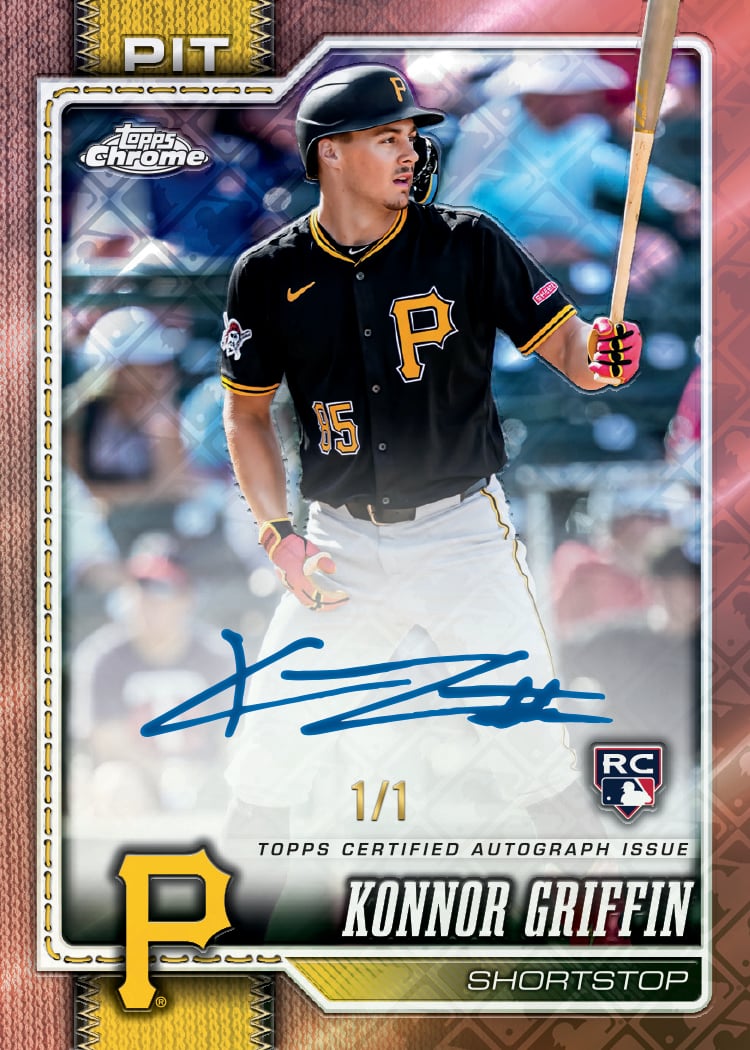
The box lists 5 cards per pack and 6 packs per box, 30 cards in all. Cases are reported at 20 boxes, but that figure isn't Topps': its product page doesn't list a configuration.
Topps doesn't publish the pack mix either. The reported mix is two LogoFractors in each pack, 12 a box, with regular 2026 Topps Chrome base cards in the other slots, three a pack if that count holds. Neither this sheet nor the main Chrome sheet has a line for those regular cards. So the sheet speaks for about 12 of the 30 cards in a box, and the rest of this piece is about those cards unless it says otherwise.
Add up the sheet's lines, take the reported two-a-pack mix for the first two rows, and here's what an average box holds:
| Per box (6 packs, 30 cards) | |
|---|---|
| Regular Chrome base cards, if a pack holds three | 18 |
| Base LogoFractor, no color | at least 6, about 7.8 at two LogoFractors a pack |
| Numbered base parallels, Pink through Rose Gold | 1.65 |
| 1991 Topps, any version | 0.67 |
| Big Ticket Players, any version | 0.56 |
| Wrecking Crew, any version | 0.56 |
| Future Stars, any version | 0.22 |
| Perspectives, any version | 0.22 |
| Image Variations, any version | one in 8 boxes |
| Rookie Autographs, any version | one in 4.9 boxes |
Every line but the base LogoFractor adds up to 0.70 a pack, 4.2 a box. Put the base at its printed 1:1 and the sheet comes to at least 1.7 LogoFractors a pack, so two a pack fits it, but the sheet can't prove it. At two a pack, about 7.8 of the 12 are the base version with no color, about 1.3 a pack, which the sheet would still print as 1:1 because it rounds up (more on that below).
Autographs run one every 29 packs, about 0.21 a box and about four to a 20-box case. About five in eight of them are numbered (0.13 a box), against one every 13 boxes for the version with no color. A numbered LogoFractor of any kind, autographs and Rose Golds included, comes to about two a box.
The checklist
Topps' checklist runs 495 cards in eight sections, all of them LogoFractors. It names 302 players.
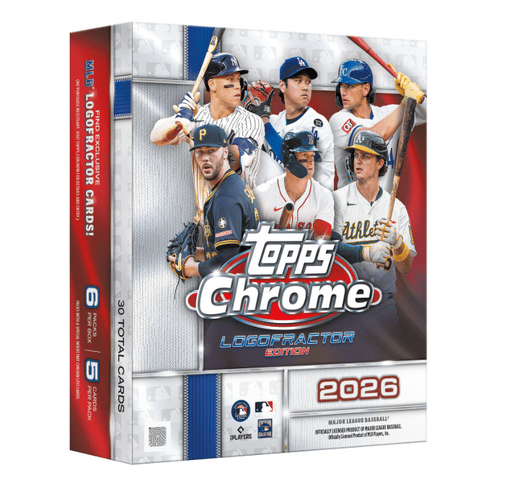
The base set is the same 300 cards as 2026 Topps Chrome Baseball, from Shohei Ohtani (#1) to Garrett Crochet (#300), with Aaron Judge at #100, Paul Skenes at #150 and Mike Trout at #200. Topps tags 67 of them as rookies, among them Konnor Griffin, Kevin McGonigle, Munetaka Murakami, JJ Wetherholt, Roman Anthony, Jac Caglianone, Samuel Basallo, Kazuma Okamoto, Tatsuya Imai and Bryce Eldridge.
Image Variations cover 50 of those cards under their base numbers, 18 of them rookies.
The inserts:
- 1991 Topps, 30 cards on the 1991 design: 15 veterans from Ohtani to Skenes, then 15 rookies from Colson Montgomery to Eldridge.
- Big Ticket Players, 25, from Trout to Basallo.
- Wrecking Crew, 25, from Judge to Anthony.
- Future Stars, 10, from Murakami to Carson Benge, eight rookies plus Nick Kurtz and Skenes.
- Perspectives, 10, from Caglianone to Derek Jeter. Jeter and Albert Pujols are the only two players in the product without a base card.
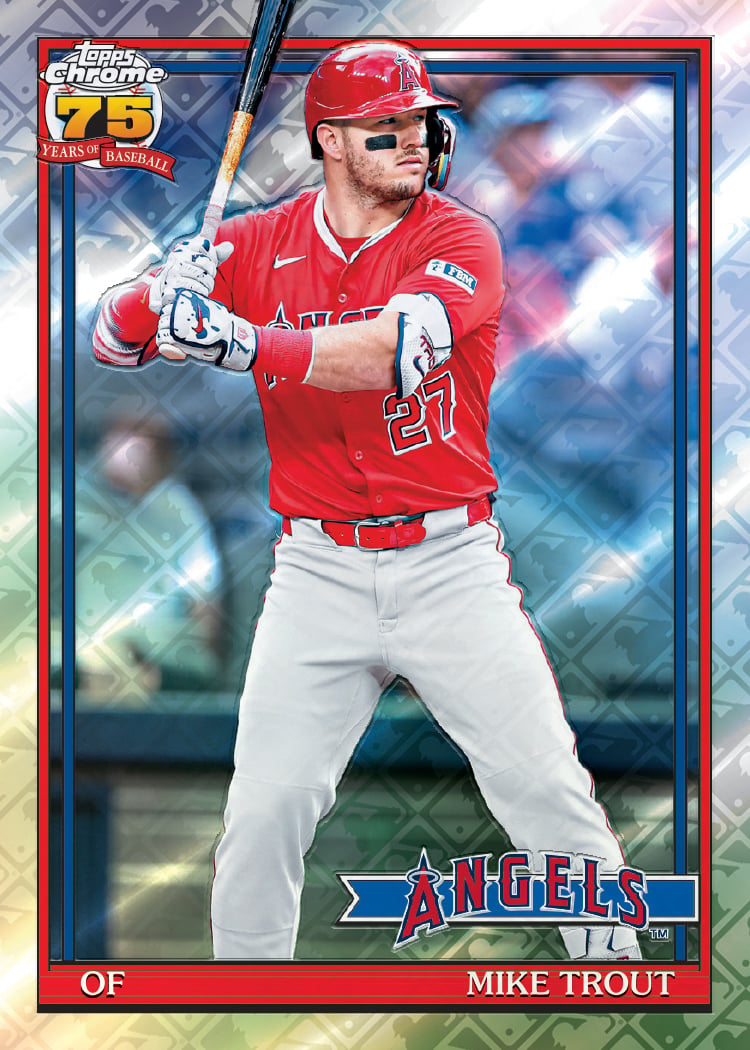
LogoFractor Rookie Autographs have 45 signers, every one a rookie from the base set, with Griffin, Murakami, Okamoto, Imai, McGonigle, Wetherholt, Anthony, Caglianone and Basallo among them. The other 22 base-set rookies don't sign, Benge, Kyle Teel and Jakob Marsee among them.
Five signers carry a different team on the autograph than on their base card in Topps' checklist: Owen Caissie (Cubs on the autograph, Marlins on the base), Harry Ford (Mariners, Nationals), Jhostynxon Garcia (Red Sox, Pirates), Jacob Melton (Astros, Rays) and Warming Bernabel (Rockies, Nationals).
Anthony is the only player in all eight sections. Caglianone and Basallo are each in seven.
The base ladder
Odds per pack. Topps' sheet prints no serial numbers, so the print runs below are the ones in our data, and the odds check them.
| Parallel | Print run in our data | Odds |
|---|---|---|
| LogoFractor, no color | - | 1:1 |
| Pink | /250 | 1:10 |
| Blue | /150 | 1:16 |
| Green | /99 | 1:24 |
| Purple | /75 | 1:31 |
| Gold | /50 | 1:47 |
| Orange | /25 | 1:93 |
| Black | /10 | 1:232 |
| Red | /5 | 1:463 |
| Rose Gold | 1/1 | 1:2,286 |
Counting every color, there are 665 numbered copies of each base card, from the Pink /250 down to the Rose Gold.
Multiply a tier's print run by its odds and by the 300 cards, and the Purple and the Orange both come to 697,500 packs (75 x 31 x 300 and 25 x 93 x 300), the Black to 696,000 and the Red to 694,500. The Gold, at 705,000, and the Green, at 712,800, are shorter lines that land within their rounding of the same figure, and the Pink and Blue are too short to read closely. A wrong run would stick out: a /20 Orange would point to 558,000. So the runs in our data hold.
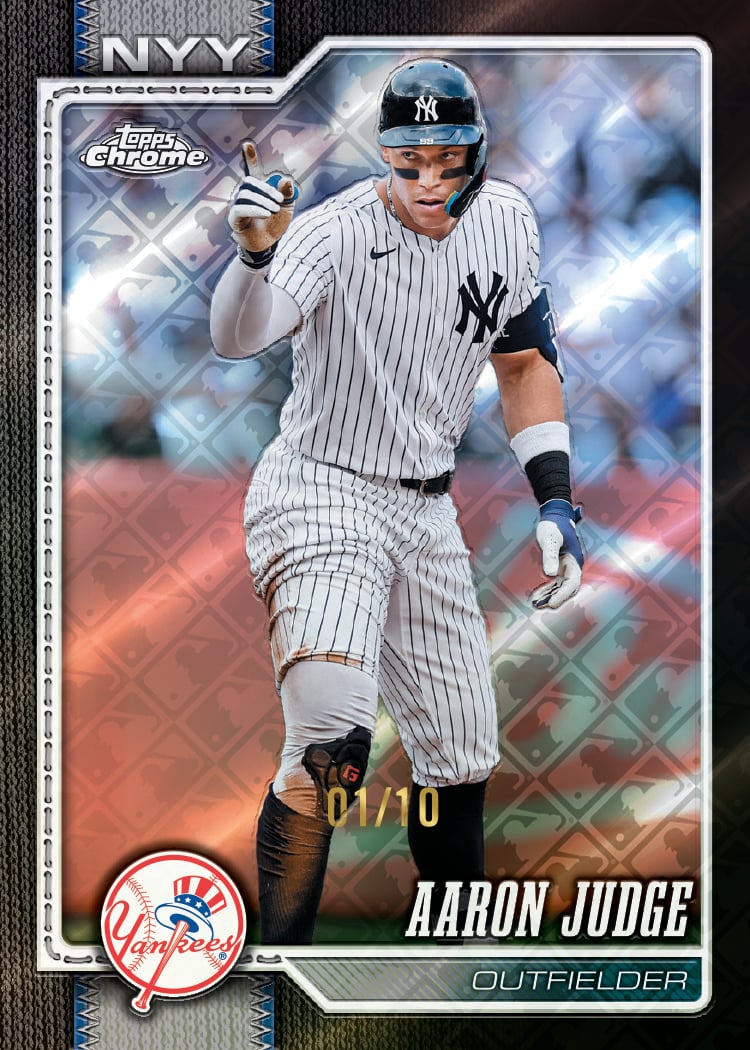
The Aaron Judge below is a Black numbered 01/10, which fits the /10. A Yordan Alvarez Orange numbered 01/25 and a Murakami Rose Gold numbered 1/1 fit the ladder too.
The Image Variations and inserts
Odds per pack:
| Version | Print run in our data | Image Variations (50) | 1991 Topps (30) | Big Ticket Players and Wrecking Crew (25 each) | Future Stars and Perspectives (10 each) |
|---|---|---|---|---|---|
| No color | - | 1:70 | 1:10 | 1:12 | 1:30 |
| Green | /99 | - | 1:235 | 1:282 | 1:702 |
| Purple | /75 | - | 1:310 | 1:371 | 1:926 |
| Gold | /50 | 1:279 | 1:464 | 1:557 | 1:1,389 |
| Orange | /25 | 1:557 | 1:926 | 1:1,113 | 1:2,766 |
| Black | /10 | 1:1,389 | 1:2,310 | 1:2,766 | 1:6,858 |
| Red | /5 | 1:2,766 | 1:4,572 | 1:5,509 | 1:13,715 |
| Rose Gold | 1/1 | 1:13,715 | 1:22,400 | 1:26,880 | 1:67,200 |
Big Ticket Players and Wrecking Crew match line for line, and so do Future Stars and Perspectives.
The odds mostly follow how many copies a line has in all, whatever the color or the set. Five lines total 250 copies: the Orange on Future Stars and on Perspectives (10 cards at /25), the Black on Big Ticket Players and on Wrecking Crew (25 cards at /10) and the Red on the Image Variations (50 cards at /5). All five read 1:2,766. The three lines that total 50 copies read 1:13,715, the three that total 500 read 1:1,389, the three that total 750 read 1:926 and the three that total 1,250 read 1:557. A wrong run on any of them would break the match, so these hold too. Two pairs don't match exactly. The base Red and the 1991 Topps Gold both total 1,500 copies and read 1:463 and 1:464, and the base Rose Gold and the 1991 Topps Black both total 300 and read 1:2,286 and 1:2,310.
The versions with no color are seeded alike. Cards times odds is 300 on all five inserts (30 x 10, 25 x 12 and 10 x 30), so any one card turns up about once in 300 packs whichever insert it's from, the same as a base card at a flat 1:1. The Image Variations are much scarcer, one card in 3,500 packs (50 x 70).
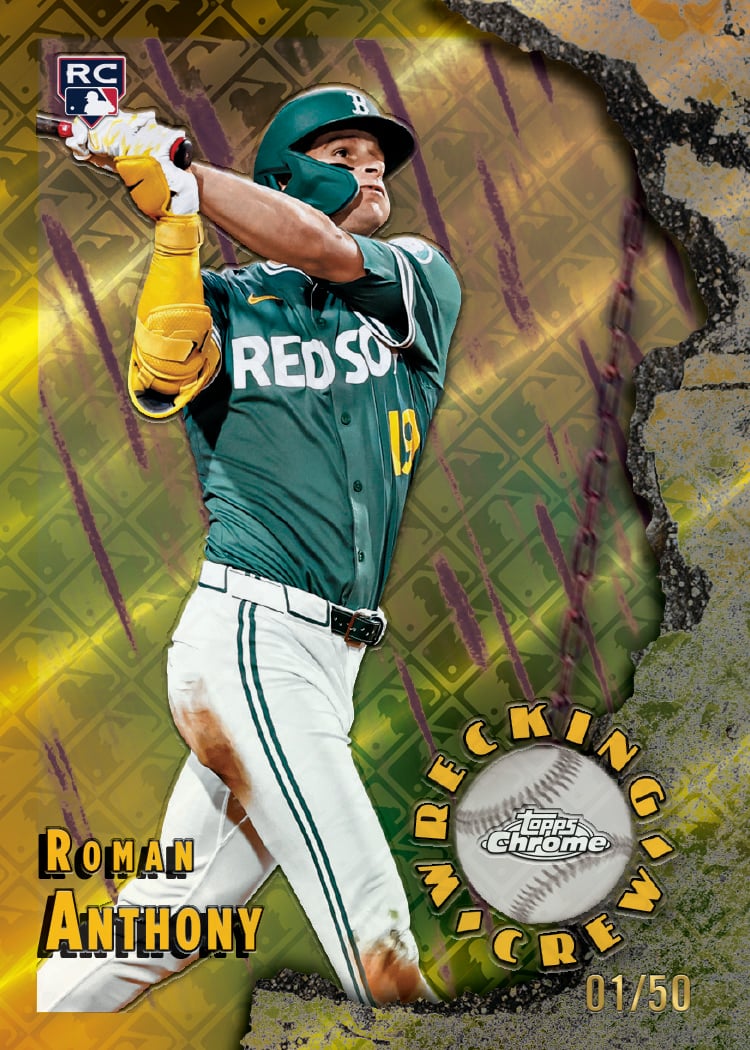
The Roman Anthony below is a Wrecking Crew Gold numbered 01/50, which fits the Gold in our data, and a Bryce Harper Wrecking Crew Red numbered 1/5 fits the Red.
The autographs
Odds per pack. "Printed" is the run in our data times all 45 signers, and "in packs" is what the odds come to at 672,000 packs (the next section shows where that comes from):
| Version | Print run in our data | Odds | In packs | Printed | Share |
|---|---|---|---|---|---|
| No color | - | 1:80 | 8,400 | - | - |
| Blue | /150 (unconfirmed) | 1:183 | about 3,680 | 6,750 | 54% |
| Green | /99 | 1:182 | about 3,700 | 4,455 | 83% |
| Purple | /75 | 1:249 | about 2,700 | 3,375 | 80% |
| Gold | /50 | 1:361 | about 1,860 | 2,250 | 83% |
| White | /30 | 1:599 | about 1,120 | 1,350 | 83% |
| Orange | /25 | 1:727 | 925 | 1,125 | 82% |
| Black | /10 | 1:1,847 | 364 | 450 | 81% |
| Red | /5 | 1:3,394 | 198 | 225 | 88% |
| Rose Gold | 1/1 | 1:16,800 | 40 | 45 | 89% |
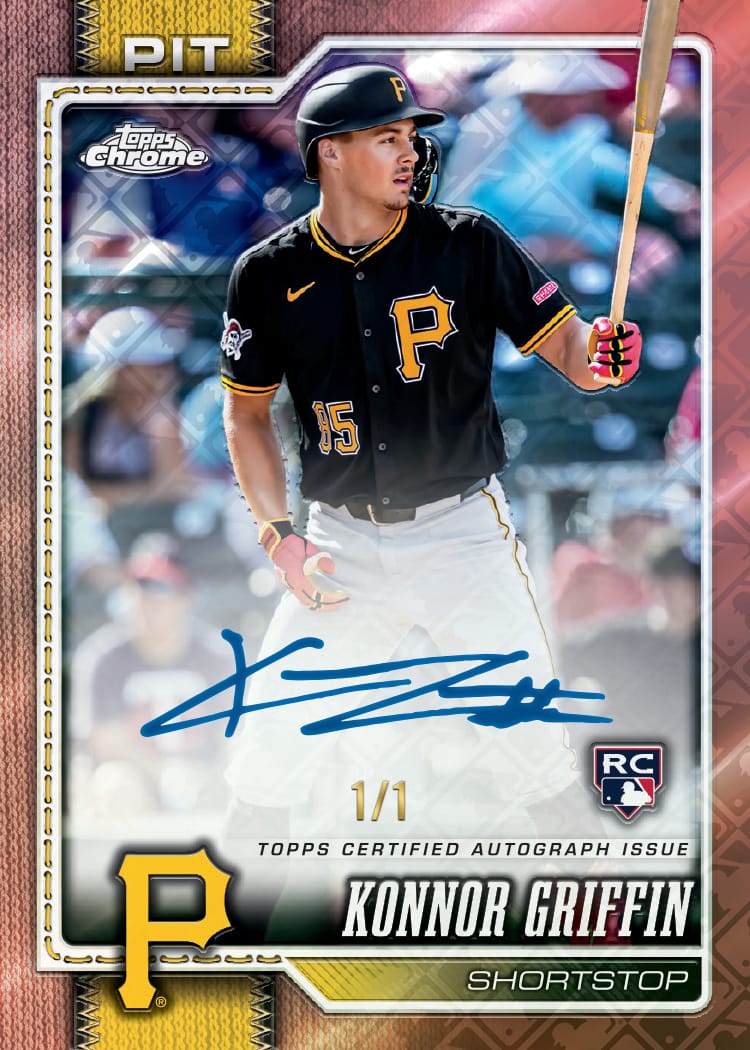
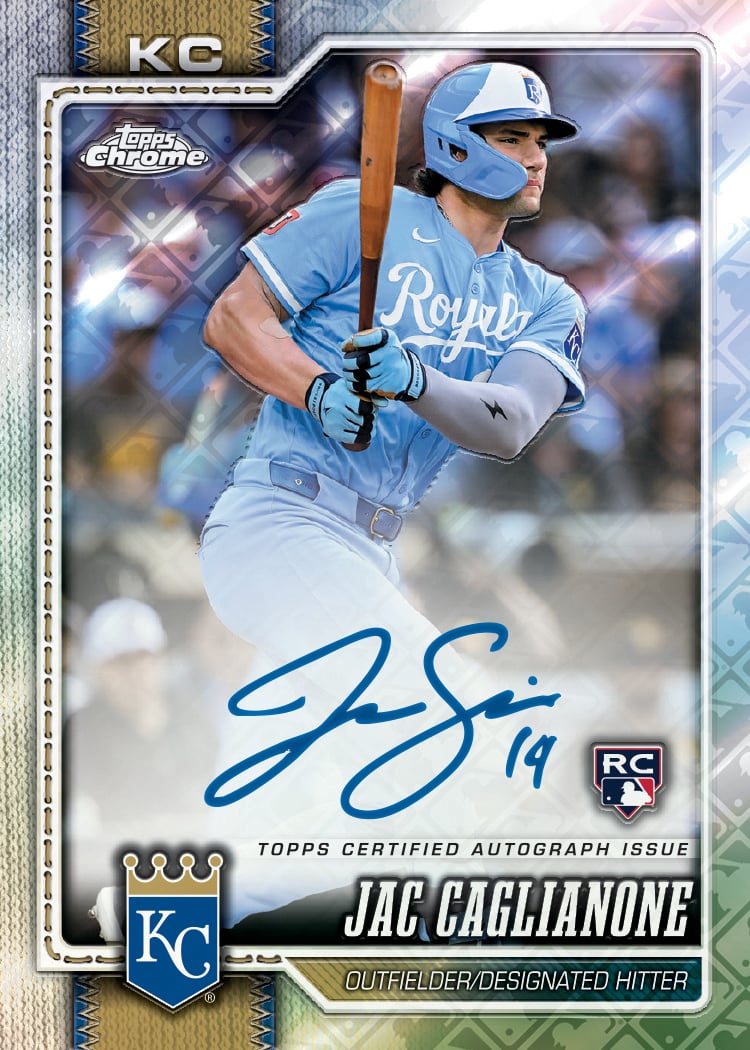
The White /30 is the one color only the autographs have. The Griffin at the top of this piece is a Rose Gold numbered 1/1. The Caglianone below is the version with no color and has no serial number on the front.
Every other ladder in the product runs about 96 to 98 percent once the shortest lines' rounding is allowed for. This one doesn't. At that fill, the Green through the Black come to about 37 to 39 signers' worth of cards and the Red to about 41, and the Rose Gold counts exactly 40. The odds can't say why. Either six to eight signers skip most of the ladder, or a share of each signer's run stays out of packs, or the line was worked out on a smaller count than the 45 on the checklist. Topps' note on the sheet says a player on the checklist isn't guaranteed to appear in every parallel.
The Blue is out on its own. At /150 against /99, the Blue should be about one and a half times as common as the Green. Instead the sheet has it a pack rarer, 1:183 to 1:182, and it comes to the same 82 or so cards per signer. Filled like the Green, a Blue /150 would read about 1:120. Worked the other way, the Blue line behaves like a second /99, or like a /150 on about 30 of the 45 signers, or the line itself could be off. Last year's set had them the usual way round, Blue 1:29 to Green 1:40. The /150 isn't confirmed: Topps' sheet prints no print runs, and we haven't seen a serial number on a Blue autograph. It stays /150 in our data until one turns up, so the Blue's row above is provisional.
How many packs the sheet covers
The Rose Gold lines are the key. A one-of-one line counts copies directly, so its odds times the cards in its set is the pack count, if every one of them is in a pack:
| Line | Cards | Odds | Cards x odds |
|---|---|---|---|
| 1991 Topps Rose Gold | 30 | 1:22,400 | 672,000 |
| Big Ticket Players Rose Gold | 25 | 1:26,880 | 672,000 |
| Wrecking Crew Rose Gold | 25 | 1:26,880 | 672,000 |
| Future Stars Rose Gold | 10 | 1:67,200 | 672,000 |
| Perspectives Rose Gold | 10 | 1:67,200 | 672,000 |
So the sheet is figured on 672,000 packs: 112,000 boxes of six, and at 5 cards a pack about 3.4 million cards. At the reported 20 boxes a case that's 5,600 cases, and at two LogoFractors a pack about 1.3 million of the cards are LogoFractors and about 2 million are regular Chrome cards. That's the count the odds point to, not a counted print run. Topps' note on the sheet says its odds reflect the intended configuration and that actual contents and odds may vary, so the run that actually gets packed out can differ.
The other three Rose Gold lines land above that: 685,800 on the base (300 x 2,286), 685,750 on the Image Variations (50 x 13,715) and 756,000 on the autographs (45 x 16,800). None of those can be the pack count, since at 685,800 packs the 1991 Topps line would need more than 30 Rose Golds on a 30-card set. At 672,000 they come out to whole cards: 294 base, 49 Image Variations and 40 autographs.
This sheet rounds up, not to the nearest pack. The 147 1991 Topps Reds in packs come to one every 4,571.4 packs, and the sheet prints 1:4,572, where the nearest pack would read 1:4,571. The 49 Image Variations Rose Golds come to one every 13,714.3, printed 1:13,715. We tried every pack count from 200,000 to 1.2 million. Rounding up, only 671,991 to 672,000 gives a whole number of cards on all 65 lines above 1:1, and 672,000 is the only one of those that makes whole cases of 20. Rounded to the nearest pack or down, no count fits.
So every line here is at least as good as printed, and the counts in this piece are floors.
Not every numbered card is in a pack
If every Rose Gold on those five lines is in a pack, here's the least the odds put in packs on each numbered tier:
| Ladder (cards) | Green /99 | Purple /75 | Gold /50 | Orange /25 | Black /10 | Red /5 | Rose Gold |
|---|---|---|---|---|---|---|---|
| Base (300) | 94% | 96% | 95% | 96% | 97% | 97% | 294 of 300 |
| Image Variations (50) | - | - | 96% | 97% | 97% | 97% | 49 of 50 |
| 1991 Topps (30) | 96% | 96% | 97% | 97% | 97% | 98% | 30 of 30 |
| Big Ticket Players and Wrecking Crew (25 each) | 96% | 97% | 97% | 97% | 97% | 98% | 25 of 25 |
| Future Stars and Perspectives (10 each) | 97% | 97% | 97% | 97% | 98% | 98% | 10 of 10 |
| Rookie Autographs (45) | 83% | 80% | 83% | 82% | 81% | 88% | 40 of 45 |
On the base ladder that's at least 7,226 of the 7,500 Oranges, 2,897 of the 3,000 Blacks and 1,452 of the 1,500 Reds. The base Green and Gold look low only because their odds are short: at 96.8 percent of its run, every base tier from the Pink to the Red prints exactly the odds on the sheet. There can't be more than 30 Rose Golds on a 30-card set, so about 97 to 98 percent is the most the odds allow on the numbered tiers there. Either a few copies of each tier stay out of packs, or a few cards in each hundred skip a tier.
The smaller tiers come out to whole cards:
| Tier | Printed | In packs |
|---|---|---|
| Future Stars and Perspectives Red /5 | 50 each | 49 each |
| Image Variations Rose Gold | 50 | 49 |
| Future Stars and Perspectives Black /10 | 100 each | 98 each |
| Big Ticket Players and Wrecking Crew Red /5 | 125 each | 122 each |
| 1991 Topps Red /5 | 150 | 147 |
| Future Stars and Perspectives Orange /25 | 250 each | 243 each |
| Big Ticket Players and Wrecking Crew Black /10 | 250 each | 243 each |
| Image Variations Red /5 | 250 | 243 |
| 1991 Topps Black /10 | 300 | 291 |
| Base Rose Gold | 300 | 294 |
A tier loses 2 to 3 percent however it's built. Six base cards and one Image Variation look to have no Rose Gold in packs, on top of the five autographs.
The cards with no print run
The same pack count estimates the cards with no print run: packs divided by odds, divided by the cards in the set. These are floors, since the sheet rounds up.
| Card | Cards | Odds | Copies of each card |
|---|---|---|---|
| LogoFractor Rookie Autographs, no color | 45 | 1:80 | about 187 (8,400 in all) |
| Image Variations, no color | 50 | 1:70 | 192 (9,600 in all) |
| Future Stars, no color | 10 | 1:30 | 2,240 (22,400 in all) |
| Perspectives, no color | 10 | 1:30 | 2,240 (22,400 in all) |
| Big Ticket Players, no color | 25 | 1:12 | 2,240 (56,000 in all) |
| Wrecking Crew, no color | 25 | 1:12 | 2,240 (56,000 in all) |
| 1991 Topps, no color | 30 | 1:10 | 2,240 (67,200 in all) |
| Base LogoFractor, no color | 300 | 1:1 | at least 2,240, about 2,900 at two LogoFractors a pack (see below) |
The 1:10 and 1:12 lines are short enough that the rounding could add up to about 10 percent, so a 1991 Topps card could run as high as about 2,490 copies and a Big Ticket Players or Wrecking Crew card about 2,440.
The no-color autograph, about 187 copies of each signer, is scarcer than a Pink /250. If it's spread over 40 signers rather than 45, that's 210 of each. The no-color Image Variation, at 192, sits in the same spot, and it's about one twelfth as common as the insert cards.
The base count is the roughest. At a flat 1:1 on 300 cards, the floor is 2,240 of each. If a pack really holds two LogoFractors, the base takes what's left after every other line: 1.30 a pack, about 872,000 in all, or about 2,900 of each of the 300.
The regular Chrome cards in each pack, three at the reported mix, can't be counted from a line, since neither sheet has one. If all three are base cards, that's about 2 million cards, about 6,700 more of each of the 300 on top of the main Chrome release.
The rarest pulls
The longest lines on the sheet are the Future Stars and Perspectives Rose Golds at 1:67,200 packs each, about one in 11,200 boxes. Each has 10 cards, and the odds put all 20 in packs.
Next are the Big Ticket Players and Wrecking Crew Rose Golds at 1:26,880 (25 cards each, one in 4,480 boxes), the 1991 Topps Rose Gold at 1:22,400 (30 cards, about one in 3,730 boxes) and the autograph Rose Gold at 1:16,800 (40 cards in packs, one in 2,800 boxes). After those come the Image Variations Rose Gold and the Future Stars and Perspectives Reds, all at 1:13,715, about one in 2,290 boxes.
Counting every Rose Gold line together, the odds put 483 in packs, 12 fewer than the 495 cards on the checklist: one every 1,391 packs, or about one every 232 boxes. On its own line, a base Rose Gold is one in 381 boxes.
What to watch
The things we're watching: the first serial number on a Blue autograph; whether autograph Rose Golds surface for all 45 signers; which signers turn out to skip a color; how many LogoFractors a pack really holds, which moves the base count; and how many boxes a case really holds. We'll update this piece if any of that changes.
The full checklist and every parallel with its print run and odds are on the 2026 Topps Chrome Logofractor Baseball release page, and you can track what you pull in HobbyMonitor Collections.
This is not financial advice. These are cards. The data and analysis are here to inform. You make your own calls.
This article was generated with the assistance of AI and reviewed before publishing. Always verify latest market data, stats, or news.
Published: August 2026