2026 Bowman Chrome: HobbyMonitor's Top Chases and Recommendations
The 2026 edition naturally sold out its direct Hobby allocation on pre-order day one. The checklist carries 82 players making their 1st Bowman appearance, 80 of them with on-card Chrome Prospect Autographs. I ran the full class through my deepest evaluation of the year: stats, scouting grades, signing pedigree, and the hobby lens. Here is where I landed for my chases in the product.
Understanding the Product
Let's be honest about what this product is. Most of these 17-year-old DSL kids will not pan out. That's not cynicism, it's the base expectation, and it's exactly why my recommendations this year are a bit more top-heavy on core names rather than a long sleeper list. Of all the releases on the calendar, Bowman Chrome is the one to concentrate on a few strong names and resist the urge to buy everyone.
Last year was probably the exception that proves the rule. The 2025 class produced real sleepers in Juneiker Caceres and Johan De Los Santos, and Rainiel Rodriguez was already performing when the product dropped. I recommended Rainiel and Caceres in my 2025 Bowman Chrome piece, and Rainiel has since climbed from #99 on the Top 100 to #12 on my overall board. I'll take that as license to trust the process, but I'm not counting on this class being as generous.
The configuration: 10 cards per pack, 6 packs per box, 2 Chrome Autographs per box. Release day is September 9, with presale boxes at $299 (not bad, same as last year). Odds and print runs aren't published yet; I broke down everything known about the parallels and variations in my checklist breakdown. I also have a cheat sheet for all prospects in the product by team.
My Top Chases:
Christian Zazueta (21, RHP, Dodgers)
Yes, a pitcher!
At 21, Zazueta has 67 strikeouts against seven walks with a 1.02 WHIP through 44 Double-A innings, after striking out 66 against 12 walks at High-A. That's elite command with bat-missing stuff in the sport's best pitching development org and the hobby's strongest team market, and it's carried him to #36 on the Top 100. Pitchers remain small-swing territory for me as a rule, but a Dodgers arm performing like this at Double-A with a 1st Bowman auto (CPA-CZ) in the product is the rare exception worth a real look. There's no doubt he'll be the most expensive pitcher spot in the product alongside Jurrangelo Cijntje.
Francisco Renteria (17, OF, Phillies)
The best all-around production in the class, and the most third-party validation of any DSL bat in the group.
The line: .379/.470/.682 with 11 home runs and 24 steals, and it keeps climbing. He won June Hitter of the Month, Jeff Passan called him the best player in the DSL, and reporting out of the deadline said the Phillies refused to move him. At 6-foot-3 and 200 pounds with a strikeout rate that's stayed modest for a teenage bat, he's the frames-grow-into-power archetype actually performing right now, in a rabid card market, and he's since pushed into the Top 100. CPA-FR is the auto. If he slots in as the 3rd or 4th name for many, that feels underrated.
Angeibel Gomez (17, OF, Royals)
The one DSL stat line in the class that's hardest to fake: more walks than strikeouts with real power already showing.
Gomez has drawn 28 walks against 19 strikeouts while slugging .653 with 9 home runs at 17, with 70-grade speed in center field. He was the #4 prospect in the international class and has already climbed into the Top 100, which matters more than the small Kansas City market. Hit-first now, with the power arriving ahead of schedule (CPA-AG). He's getting a ton of buzz before the product releases, and he'll be a top name for breaker pricing.
Samil Serrano (17, OF, Nationals)
New addition to this list. The best-pedigree bat I hadn't featured yet, and the discipline in the complex line backs the price tag.
The Nationals gave Serrano $1.97 million as the top name in their 2026 international class, and the debut summer has held up the bonus: .310/.430/.538 with 5 home runs, 13 steals, and 29 walks against 28 strikeouts in 48 complex-league games at 17. Even walk-to-strikeout as a teenager in his first pro season is the kind of feel-to-hit that travels. He's the No. 16 international prospect in the class, out of the same San Cristobal academy that produced Josuar Gonzalez and Emil Morales, so the developmental track record behind him is real.
The frame is the projection bet. He's a lean 6-foot-3 lefty who hasn't grown into his strength yet, a hit-over-power profile now with the pop expected to arrive as he fills out, and a defensive path that likely slides from center to a corner. A collector whose eye I trust vouched for the work ethic and the hitting approach behind the numbers, and that read lines up with the discipline on paper. CPA-SSE is the auto. He carries real signing-bonus pedigree, so he won't be free at release the way my cheaper sleepers are, and I'm keeping him in the higher-risk bucket given the distance to the majors. Among the pay-up bats, though, he's one I'm comfortable chasing.
Sebastian Dos Santos (18, SS, Cardinals)
The closest thing in this checklist to last year's Juneiker Caceres: the cheap signee nobody was watching who forced his way up two levels.
The Cardinals signed Dos Santos for $75,000, and he has spent the year earning it: a 1.015 OPS in the complex leagues, 6 home runs across those 27 games, then a push to Low-A at 18. He's held his own there as one of the youngest bats at the level, with a huge walk total (40) carrying a .239 average and a strikeout rate that's climbed against better arms, and he now sits as a top-20 Cardinals prospect with a 50 OFP from Prospects Live. This is the anti-pedigree profile that produced my best call from last year's edition, and the card (CPA-SDO) will cost next to nothing at release because the market is staring at the $5 million names.
The Sleepers
Talon Haley (20, LHP, Angels)
The best cheap arm spec in the product, with the best story in baseball.
Haley has struck out 117 batters in 85.2 innings at Low-A this season at age 20, behind a 60-grade curveball. The ERA (4.73) and WHIP (1.42) keep him well out of the top five, and I won't pretend otherwise. But a young lefty missing this many bats, who fought back from cancer treatment at St. Jude to get here, is exactly the kind of low-cost auto (CPA-TH) that can return a multiple if the run prevention catches up to the stuff. Small swing, real upside, and the hobby loves a good story.
Jaider Suarez (17, SS, Royals)
The least helium-dependent DSL line in the set, at a sleeper price.
Suarez is hitting .379/.508/.564 with 30 steals and 35 walks against 29 strikeouts at 17. What separates him from the usual DSL mirage is the paper trail: he was the youngest player on Cuba's U15 World Cup roster and led Cuba's U16 league in home runs before the Royals signed him for $1.7 million as the #22 prospect in the class. The discipline predates the org hype, and with modest current buzz the acquisition cost on CPA-JS should stay reasonable. A complex-level line keeps him in the sleeper tier for now; the profile says he won't stay there long.
Louis Andujar (18, 3B, Red Sox)
A $20,000 signee already promoted to full-season ball. Yes, twenty thousand.
Andujar tore up the complex leagues (.404 with a 1.214 OPS in 15 games) before a push to Single-A Salem, where he's now banked a real sample: .243/.352/.422 with 8 home runs, though the strikeouts (60) have climbed against older arms. He's earlier in the polish than Dos Santos, but it's the same story: a bat nobody paid for, performing his way up levels while the checklist's headliners soak up all the attention. CPA-LA is about as cheap as a lottery ticket gets in this product.
Jaiden Lo Re (19, SS, Orioles)
The name people keep sending me, and the one I'm least convinced by. That combination is usually an offseason buy, not a release-week one.
Lo Re hit .325/.439/.443 in 56 Low-A games at 19 with 41 walks against just 22 strikeouts and 16 steals, then earned a push to High-A where he's 4-for-24 so far. Bat-to-ball that clean at that age in full-season ball is a real skill, and the Orioles paid over slot ($562,500 in the fifth round out of a Tempe high school, buying him out of a BYU commitment) because they believed the hit tool.
Here's why I'm not in yet. Two home runs in 203 at-bats is the whole question. The outside grades say 40 power and 40 overall, and a 5-foot-11 infielder who slaps singles and walks is the profile that stalls at Double-A more often than it breaks out. The hit tool isn't in dispute. The impact is.
So I'm treating CPA-JLO as an offseason target rather than a release chase. The buzz right now is modest, the auto should be cheap in September, and if the power ticks up next spring the price won't stay there. I'd rather buy this one quietly in the winter than pay for the mentions.
The Marquee: Fade at Release, Buy in December
Luis Hernandez (17, SS, Giants)
The $5 million headliner of the 2026 international class, the best prospect in the product, and a card I am not buying in September.
Let's separate the player from the price. Hernandez skipped the DSL entirely, which almost never happens. He hit .298/.382/.535 with 30 extra-base hits over 228 complex-league plate appearances behind a 60-grade hit tool, then took the most aggressive assignment in the class with a promotion to Low-A San Jose. He's scuffling there (.231/.276/.319 with 29 strikeouts across roughly 100 plate appearances), and I view that as the cost of the assignment, not a hit-tool problem. The 228 good complex-league plate appearances still outvote the smaller Low-A sample, and he still ranks inside the Top 100 at #27.
The player is solid and fits the mold of guys like Josuar Gonzalez and Made who are making fast moves in their systems and I know where their rankings are ending up. The release-week price will be rough. CPA-LH will likely open as the most expensive card in the product, priced off the bonus and the buzz. My plan is to fade him at release and buy in December, when the rip-season supply has landed, the hype window has closed, and a .190-something stateside line has done its work on the price. If he turns the line around before then, I'll pay a bit more. That trade risk is fine with me.
Full disclosure on this play: I ran nearly the same fade on Josuar Gonzalez in last year's edition, and he's now a top-15 prospect in the sport. The fade was right on release-week price and wrong on the player. I'm comfortable making the same bet again, and this time I'm putting the buy-back date in writing.
Who I Am Fading
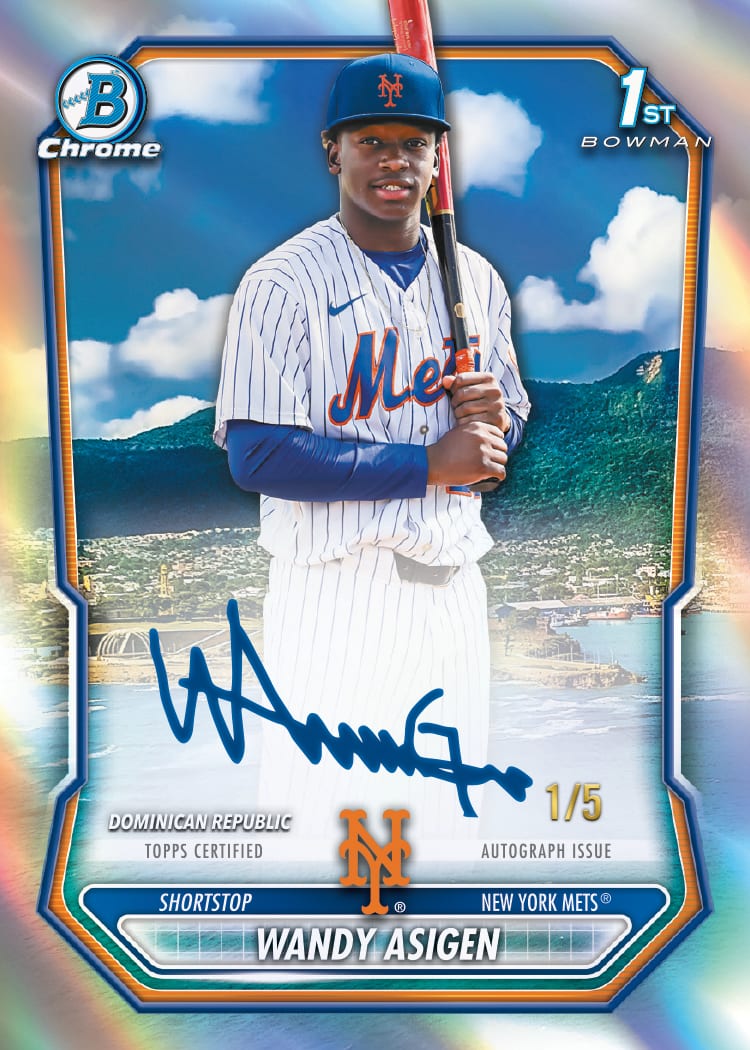
Wandy Asigen (16, SS, Mets)
This one will be unpopular. Asigen is the youngest player in the set, signed off the #2 ranking in the international class, with 110+ mph exit velocities and a New York market behind him. His complex line (.279/.470/.525) shows plenty of walks, but the outside grades still tell a power-over-hit story: Baseball America has him at 45 hit with 55 power, and MLB.com grades him 50 hit, 60 power, 45 overall, and the strikeouts agree with the grades. At the prices his pedigree and market will command, I'm out. To be clear, this is a watch, not a forever-fade: if the contact stabilizes stateside next spring, he re-enters the conversation immediately. I'd just rather pay more later for evidence than pay a premium now for hope.
Jurrangelo Cijntje (23, P, Cardinals)
The switch-pitcher novelty is genuinely fun, and novelty sells cards for a week. The performance doesn't back a hold: a 6.14 ERA with 22 walks in 36.2 Triple-A innings, with the walk rate climbing at each promotion (40 walks across 80 Double-A innings before that). Sell the novelty into whatever pop the product gives it.
Samy Natera Jr. (26, LHP, Angels)
Natera is actually pitching well in the big leagues right now (a 2.00 ERA with 42 strikeouts over 27 innings), and I'm happy for him. But a 26-year-old reliever's 1st Bowman auto is the hobby's most reliably dead card archetype, and no early-career line changes that. Not a knock on the player. A knock on the timing.
The rest of the pitching group
Outside of Zazueta and the Haley flyer, my standing rule applies: fade the arms, sell any pitcher pop immediately, hold the bats.
The Bottom Line
This is a concentrate-your-fire release. Hernandez is the marquee on a timeline: fade the September price, buy the December one. Five names earned my conviction at release prices: Zazueta as the performance outlier, Renteria and Gomez as the DSL bats with real evidence behind the hype, Dos Santos as my Caceres pick of this class, and Samil Serrano, the new addition and the pay-up Nationals bat whose complex line backs the bonus. The sleepers are Haley on the arm side, Suarez and Andujar on the bat side, and Jaiden Lo Re as an offseason target rather than a release-day buy. Everything else in the class is a rip-and-sell until proven otherwise.
Track all 82 1st Bowman prospects from this release on the HobbyMonitor Prospect Dashboard, and watch the Release Calendar for the Mega Box on September 23.
This is not financial advice. These are cards. The data and analysis are here to inform. You make your own calls.
This article was generated with the assistance of AI and reviewed before publishing. Always verify latest market data, stats, or news.
Published: August 2026