2025 Topps Chrome Platinum Baseball: The Complete Odds, Parallel, and Print Run Breakdown
2025 Topps Chrome Platinum Baseball released June 5, 2026. Topps' product page says it reimagines the 1955 design in Chrome, and its odds sheet calls it 2025 Topps Chrome Platinum 55 Baseball. The sheet has three columns, Hobby and two Value Box columns labeled SE and EA, with odds per pack and no print runs. Four base parallels and two SuperFractor lines that only come in hobby packs put the hobby run at about 2.1 million packs, and the lines the hobby shares with the Value Boxes put about 3.5 million Value Box packs beside it. From there the sheet backs up the numbered base and insert runs in our data, gives a count for the cards with no serial number, and shows where the autograph ladders come up short or run long.
The packs
Topps' page for the product now carries a description, card images, the checklist and the odds, but no box configuration, so every figure in this piece is per pack and none is per box.
The two Value Box columns are the same on every base, insert and variation line. They differ only on ten autograph lines, and by less than a quarter of a percent, so this piece treats them as one Value Box column (where they differ, the tables show the SE figure). The sheet also prints the base ladder five times and the autograph ladder twice, line for line the same. Read once, the base and insert lines fit the checklist's card counts exactly, so the copies are repeats, not extra sets.
What a pack holds, adding up the sheet:
| Card | Hobby, about one pack in | Value Box, about one pack in |
|---|---|---|
| Base card | 1 | 1 |
| Unnumbered base parallel (Refractor, X-Fractor, Prism family) | 3.4 | 1.5 |
| Numbered base parallel | 4.4 | 5.0 |
| Base version of an insert | 4.5 | 5.0 |
| Autograph | 20 | 40 |
| Image Variation | 353 | 349 |
Every autograph is on-card, according to Topps. Hobby packs are twice as likely as Value Box packs to hold one, and by the numbers below they get about 54 percent of the autographs in the product.
The checklist
Topps' checklist has 970 cards across ten sections (990 lines, since each Double Headers card lists both of its players).
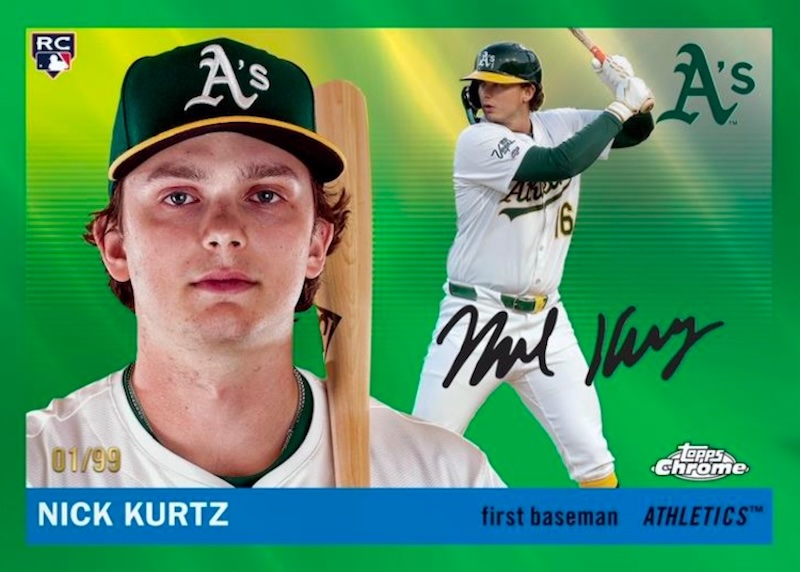
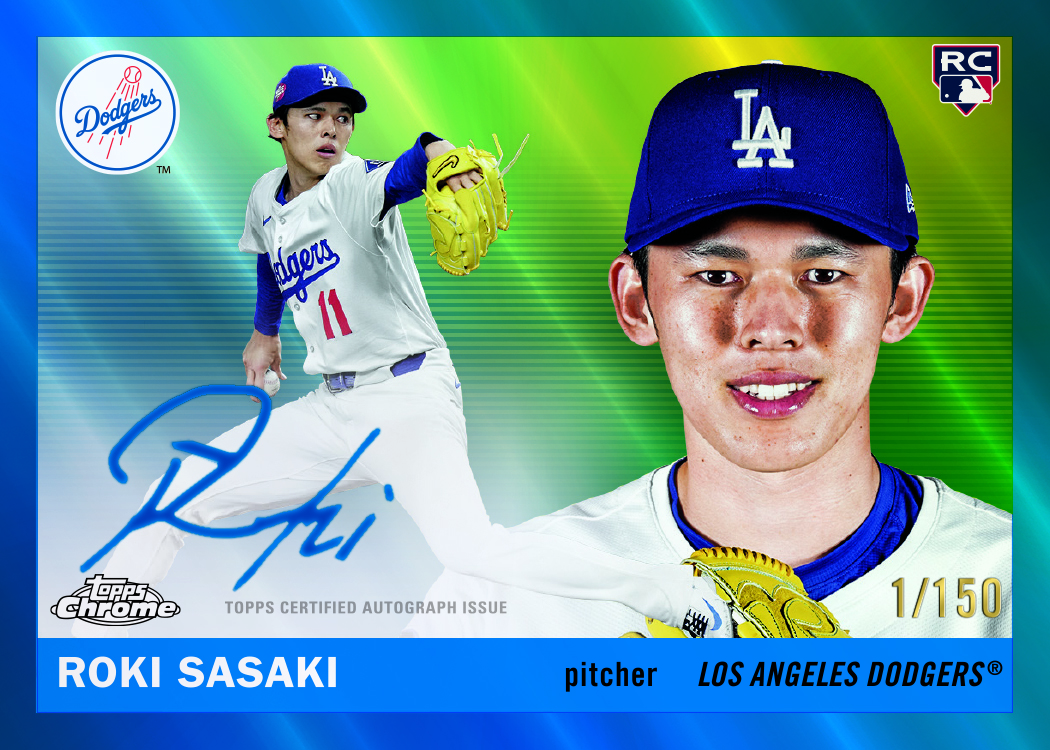
The base set is 500 cards, and Topps tags 135 of them as rookies. Cards #1 to #200 are current players, opening with Mike Trout, Jarren Duran and Shane Bieber, and only two of them are rookies (Mick Abel and Denzel Clarke). The other 133 rookies sit between #201 and #400, among them Roki Sasaki, Nick Kurtz, Jacob Wilson, Dylan Crews, James Wood, Cam Smith, Kristian Campbell and Hyeseong Kim, mixed in with retired stars and a few veterans. Most of #401 to #500 are retired players, from Babe Ruth, Lou Gehrig, Ty Cobb and Honus Wagner to Buster Posey at #500.
Base Cards Image Variations are 40 of those base numbers with a different image, from Mike Trout (#1) to Willie Mays (#469). Fourteen are rookies.
The inserts:
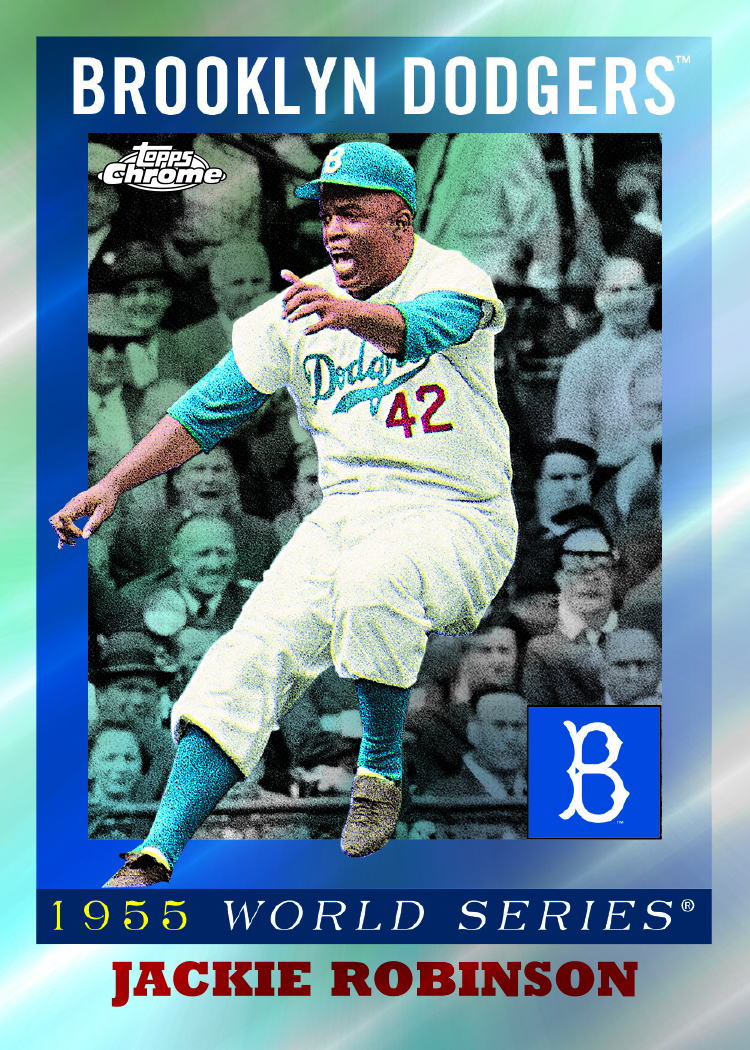
- 1955 World Series, 10 cards: six Brooklyn Dodgers (Roy Campanella, Pee Wee Reese, Jackie Robinson, Duke Snider, Gil Hodges and Sandy Koufax) and four Yankees (Casey Stengel, Yogi Berra, Whitey Ford and Mickey Mantle).
- 1955 Topps Double Headers, 20 cards with two players each, all but one pair from the same club (counting the Brooklyn and Los Angeles Dodgers as one): Koufax and Shohei Ohtani, Mantle and Aaron Judge, Ken Griffey Jr. and Ichiro, Roki Sasaki and Yoshinobu Yamamoto, Nick Kurtz and Jacob Wilson. The odd pair is #15, Vladimir Guerrero Jr. (Blue Jays) and Vladimir Guerrero (Expos), which Topps' checklist prints as 55FH-15.
- 1955 Topps Rails and Sails, 20 cards, from Juan Soto to Bryce Harper.
- 1955 Cards That Never Were, 20 cards. Topps says they show players from 1955 who didn't have a card in the original Topps set, among them Stan Musial, Whitey Ford, Bob Feller, Mickey Mantle, Larry Doby, Brooks Robinson and Casey Stengel.
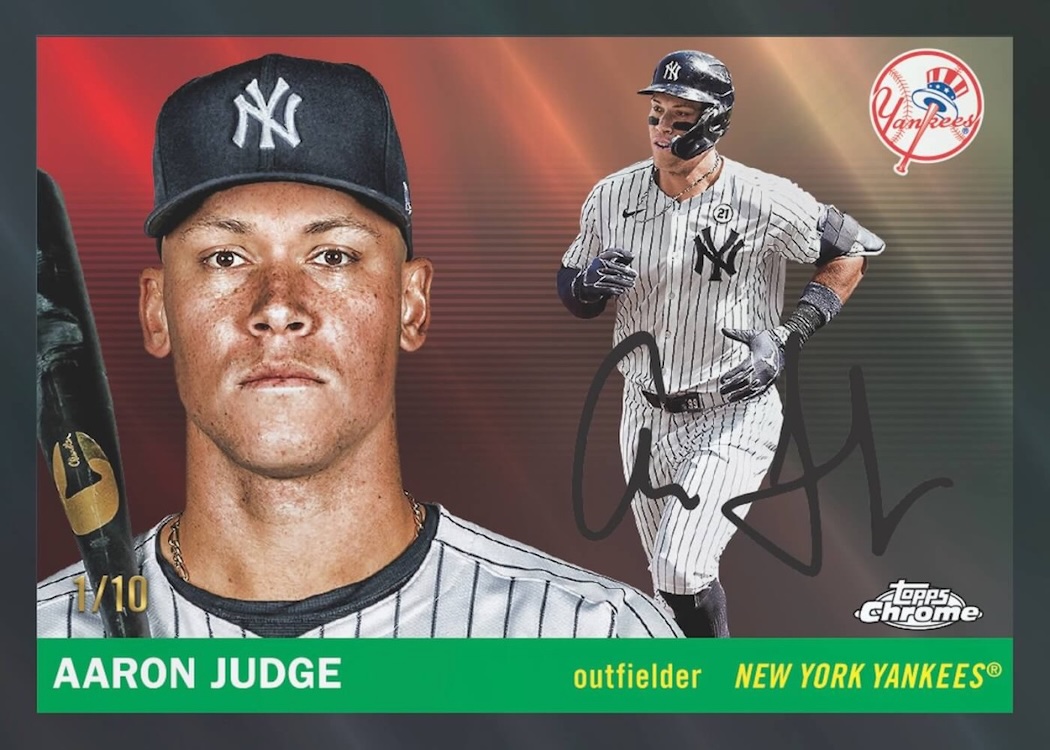
- 1955 Topps City Variations Chrome Packs, 80 cards with city skyline backgrounds, eight of them rookies.
- 1955 Topps Employee Super Short Prints, 10 cards. As the name says, the subjects are Topps employees, not players.
The autographs are Autographs, 178 cards with 75 rookies by Topps' tags (Sasaki, Kurtz, Wilson, Crews, Wood, Smith, Campbell, Matt Shaw and Marcelo Mayer among them) alongside Judge, Paul Skenes, Griffey, Derek Jeter, Ichiro, Nolan Ryan and Mike Trout, and 1955 Topps City Variations Chrome Packs Autographs, 92 cards that Topps calls a super short print chase. That set has Ohtani, Barry Bonds, Mariano Rivera and Sadaharu Oh, none of whom is in the main autograph set, and five rookies: Ben Rice, Crews, Mayer, Sasaki and Wood.
The base parallels
Odds per pack. Topps prints no runs on the sheet, so the runs below are the ones in our data. Lines that share a run and the same odds are grouped, and "each" means each line in the group:
| Parallel | Print run in our data | Hobby | Value Box |
|---|---|---|---|
| Refractor | - | 1:4 | 1:4 |
| X-Fractor | - | 1:24 | - |
| Prism | - | - | 1:4 |
| Blue Prism | - | - | 1:7 |
| Gold Prism | - | - | 1:350 |
| Red Prism | - | - | 1:7,000 |
| Topps Refractor | /499 | 1:23 | 1:23 |
| Vibrations Refractor | /250 | 1:46 | 1:45 |
| Blue Mini-Diamond | /199 | 1:57 | 1:57 |
| Blue Vibrations Refractor, Speckle Refractor | /150 | 1:76 each | 1:75 each |
| Platinum Toile Cream/Fuchsia Shimmer Refractor | /100 | 1:42 | - |
| Blue Shimmer Refractor | /100 | - | 1:71 |
| Platinum Toile White/Green, Green Wave and Green Vibrations Refractors | /99 | 1:115 each | 1:113 each |
| Rose Gold, Platinum Toile Cream/Rose Gold and Rose Gold Mini-Diamond Refractors | /75 | 1:152 each | 1:150 each |
| Diamond Etch Refractor | /55 | 1:206 | 1:204 |
| Gold, Platinum Toile Cream/Gold and Gold Vibrations Refractors | /50 | 1:227 each | 1:224 each |
| Gold Wave Refractor | /50 | 1:84 | - |
| Orange, Platinum Toile Cream/Orange and Orange Vibrations Refractors | /25 | 1:454 each | 1:448 each |
| Orange Wave Refractor | /25 | 1:168 | - |
| Black, Platinum Toile Cream/Black and Black Vibrations Refractors | /10 | 1:1,133 each | 1:1,119 each |
| Red, Platinum Toile Cream/Red and Red Vibrations Refractors | /5 | 1:2,266 each | 1:2,237 each |
| Red Lava Refractor | /5 | 1:839 | - |
| SuperFractor | 1/1 | 1:11,327 | 1:11,185 |
That's 30 numbered lines, 2,376 numbered copies of each base card, and 1,188,000 in all. Our data also lists a Blue Lava Refractor /100 that isn't on Topps' sheet; with no odds to check it against, it isn't counted here.
Every line covers the same 500 cards, so if the runs are right, a line's run times its odds should come out the same for every line in a column. For the lines in both formats, the hobby SuperFractor is 11,327, the Red Refractor is 5 times 2,266, or 11,330, and the Black 11,330, the Orange 11,350, the Gold 11,350, the Diamond Etch 11,330 and the Rose Gold 11,400. The /499, /250 and /150 lines come to 11,400 to 11,500. The Value Box column runs the same way, from 11,185 (the SuperFractor) to 11,477 (the /499 at 1:23). Those small differences are Topps' rounding, and they show which way it rounds: up. Read that way, a printed 1:46 means one in somewhere over 45 and up to 46 packs, every line in both formats fits a full run at a single figure (about 11,326 in hobby and 11,185 in Value Boxes), and so does every insert ladder further down. Rounded to the nearest whole number instead, no single figure fits them all. A wrong run would stick out: a Diamond Etch at /50 would come to 10,300. So the runs in our data hold.
The parallels that come in only one format check out too. The four hobby-only lines all come to the same figure: the Platinum Toile Cream/Fuchsia Shimmer (/100 at 1:42), the Gold Wave (/50 at 1:84) and the Orange Wave (/25 at 1:168) are each 4,200, and the Red Lava (/5 at 1:839) is 4,195. That's 37 percent of the shared lines' 11,330, because a hobby-only line puts its whole run in hobby packs, where a shared line puts only part of it. The Value Box only Blue Shimmer (/100 at 1:71) comes to 7,100, 63 percent of the Value Box figure. The two shares add up to about 100 percent: hobby packs hold about 37 percent of every numbered base parallel both formats share, and Value Box packs about 63 percent. A base SuperFractor is about 185 of the 500 in hobby and about 315 in Value Boxes.
Taken at face value, the odds on the 30 lines put about 1,178,000 numbered base parallels in packs, 99.2 percent of the 1,188,000. Since Topps rounds up, that's a floor, and at the pack counts below every one of the 30 lines fits its full run, so all 1,188,000 are in packs, about 478,000 of them in hobby packs.
The Prism family is Value Box only, and none of it has a run on the sheet or in our data. At about 3.5 million Value Box packs, the Prism (1:4) comes to at least about 1,760 copies of each card, the Blue Prism (1:7) at least about 1,000, the Gold Prism (1:350) about 20 and the Red Prism (1:7,000) about 500 in all, close to one of each card. With odds that short, Topps' round-up leaves room for up to a third more Prisms and a sixth more Blue Prisms. The X-Fractor is hobby only at 1:24, about 87,300 cards, or about 175 of each (up to about 182).
The Image Variations
Odds per pack:
| Version | Cards | Hobby | Value Box |
|---|---|---|---|
| Image Variation | 40 | 1:354 | 1:350 |
| Image Variation SuperFractor | 40 | 1:141,577 | 1:139,807 |
The Image Variations come to about 400 copies of each card, about 5,900 in hobby packs and 10,100 in Value Box packs, 16,000 in all. The SuperFractor line puts all 40 in packs, one of each, with about 15 in hobby.
The inserts
Hobby odds per pack. In the Value Box column every line runs about 1.25 percent shorter (the World Series SuperFractor is 1:559,228), except the base versions of the first three sets, which are the same in both:
| Insert | Cards | Base version | Green /99 | Gold /50 | Orange /25 | Black /10 | Red /5 | SuperFractor |
|---|---|---|---|---|---|---|---|---|
| 1955 World Series | 10 | 1:10 | 1:5,721 | 1:11,327 | 1:22,653 | 1:56,631 | 1:113,262 | 1:566,307 |
| 1955 Topps Rails and Sails | 20 | 1:20 | 1:2,861 | 1:5,664 | 1:11,327 | 1:28,316 | 1:56,631 | 1:283,154 |
| 1955 Topps Double Headers | 20 | 1:20 | 1:2,861 | 1:5,664 | 1:11,327 | 1:28,316 | 1:56,631 | 1:283,154 |
| 1955 Topps Employee Super Short Prints | 10 | 1:22,653 | - | - | - | - | - | 1:566,307 |
Two sets come in hobby packs only:
| Insert | Cards | Base version | Refractor | SuperFractor |
|---|---|---|---|---|
| 1955 Cards That Never Were | 20 | 1:240 | 1:2,400 | 1:106,497 |
| 1955 Topps City Variations Chrome Packs | 80 | 1:60 | 1:2,400 | 1:26,279 |
The runs are the ones in our data, and they're exact. At about 2.1 million hobby and 3.5 million Value Box packs, the World Series Green comes to about 366 cards in hobby and 624 in Value Box packs, 990 in all, which is 10 cards at /99. Its Gold is 500, Orange 250, Black 100, Red 50 and SuperFractor 10, every one a full run. Rails and Sails and Double Headers come to 1,980, 1,000, 500, 200, 100 and 20, full runs on 20 cards. The Employee SuperFractor puts all 10 in packs too.
The base versions, with no serial number:
- 1955 World Series at 1:10 comes to about 562,000 cards, about 56,200 of each. 1:10 is a short line and Topps rounds up, so that's a floor: anything from about 56,200 to 62,400 of each fits.
- Rails and Sails and Double Headers at 1:20 are about 281,000 each, about 14,000 of each card (14,000 to 14,800).
- City Variations Chrome Packs at 1:60 are about 35,000 cards, and Cards That Never Were at 1:240 about 8,750. Both come to about 440 of each card, all in hobby.
- The Refractors of those two hobby-only sets both print 1:2,400, about 875 cards each. That's about 44 of each Cards That Never Were card, a tenth of its base version, but only about 11 of each City Variation, a fortieth of its base version. The sheet gives the same odds for two sets of different sizes, and nothing on it says whether that's by design.
- The Employee Super Short Prints live up to the name. The base version falls 1:22,653 in hobby, the same odds as a World Series Orange /25, and comes to about 250 cards in all, about 25 of each, with about 93 in hobby packs.
The hobby-only SuperFractors are the two lines that don't come out whole. City Variations at 1:26,279 puts 79.8 of its 80 in packs and Cards That Never Were at 1:106,497 puts 19.7 of its 20. The shortfall is less than one card on each.
The autographs
Odds per pack, with the runs in our data. "Base" is the version with no color:
| Autographs | Print run in our data | Hobby | Value Box |
|---|---|---|---|
| Base | - | 1:43 | 1:79 |
| Refractor | /199 | 1:183 | 1:337 |
| Aqua | /150 | 1:236 | 1:435 |
| Blue Prism | /99 | 1:169 | - |
| Platinum Toile Cream/Blue | /99 | 1:315 | 1:581 |
| Green Mini-Diamond | /75 | - | 1:349 |
| Diamond Etch Refractor | /55 | 1:533 | 1:982 |
| Gold | /50 | 1:539 | 1:992 |
| Orange | /25 | 1:552 | - |
| Pink | /15 | 1:846 | - |
| Black | /10 | 1:2,424 | 1:4,468 |
| Red | /5 | 1:4,853 | 1:8,925 |
| Platinum Toile Cream/Red Refractor | /5 | 1:4,853 | 1:8,925 |
| SuperFractor | 1/1 | 1:24,089 | 1:44,739 |
The autographs split differently from the base parallels: on every line both formats share, hobby packs hold about 52 percent and Value Box packs about 48 percent. The Sasaki above, numbered 1/150, fits the Aqua's run.
The base autograph comes to about 93,300 cards, about 48,750 in hobby and 44,600 in Value Box packs, or about 525 of each of the 178 signers (525 to 535 with Topps' rounding up on 1:43 and 1:79). Counting every version, there are about 192,800 autographs in packs.
The City Variation autographs have no base version on the sheet, just two lines:
| City Variations Chrome Packs Autographs | Hobby | Value Box |
|---|---|---|
| Refractor | 1:7,843 | 1:14,469 |
| SuperFractor | 1:38,913 | 1:72,343 |
That's one about every 6,500 hobby packs and every 12,100 Value Box packs, which fits Topps' super short print label.
How many packs the sheet covers
The lines that come only in hobby packs pin the hobby run:
| Line | Cards | Run | Odds | Cards x run x odds |
|---|---|---|---|---|
| Base Platinum Toile Cream/Fuchsia Shimmer | 500 | /100 | 1:42 | 2,100,000 |
| Base Gold Wave | 500 | /50 | 1:84 | 2,100,000 |
| Base Orange Wave | 500 | /25 | 1:168 | 2,100,000 |
| Base Red Lava | 500 | /5 | 1:839 | 2,097,500 |
| City Variations SuperFractor | 80 | 1/1 | 1:26,279 | 2,102,320 |
| Cards That Never Were SuperFractor | 20 | 1/1 | 1:106,497 | 2,129,940 |
The first four use the runs in our data. The two SuperFractor lines don't need them, and they land within 1.5 percent. So the hobby run is about 2.1 million packs. Because Topps rounds up, each figure in the last column is the most packs that line allows with every card in a pack. The Red Lava sets the lowest cap, 2,097,500, and with all four base lines full the hobby run sits between 2,095,000 and 2,097,500 packs. That's why the two SuperFractor lines come out a hair short of whole. Either one taken as complete would put more Red Lavas in packs than a /5 on 500 cards can make.
The Value Box run follows from the lines both formats share. Read with Topps' rounding up, all 45 of them (the 25 shared base lines, the World Series, Rails and Sails and Double Headers ladders, and the Employee and Image Variation SuperFractors) come out whole together, and with the hobby run between 2,095,000 and 2,097,500 that takes about 3,521,000 to 3,523,500 Value Box packs. The base SuperFractor shows how: about 185 of its 500 fall in hobby packs at 1:11,327, and the other 315 at 1:11,185 take about 3.52 million Value Box packs. The Value Box only Blue Shimmer (/100 at 1:71) allows anything from 3,500,000 to 3,550,000, so it fits too. So there are about 3.5 million Value Box packs, about 63 percent of the 5.6 million packs the sheet covers. The total is the firmest figure: whatever the split, the shared lines hold it between 5.59 and 5.66 million. The sheet can't split the Value Box packs between the SE and EA columns, since their odds match.
Topps doesn't give cards per pack or packs per box for this product, so the run can't be turned into boxes or cases.
Not every numbered card is in a pack
The base and insert ladders are full. The autograph ladders aren't. Here's what the odds put in packs, at about 2.1 million hobby and 3.5 million Value Box packs, against a full run on all 178 signers:
| Autographs tier | Run | Cards in packs | Full run on 178 | Share |
|---|---|---|---|---|
| Refractor | /199 | about 21,900 | 35,422 | 62% |
| Aqua | /150 | about 17,000 | 26,700 | 64% |
| Blue Prism (hobby only) | /99 | about 12,400 | 17,622 | 70% |
| Platinum Toile Cream/Blue | /99 | about 12,700 | 17,622 | 72% |
| Green Mini-Diamond (Value Box only) | /75 | about 10,100 | 13,350 | 76% |
| Diamond Etch Refractor | /55 | about 7,500 | 9,790 | 77% |
| Gold | /50 | about 7,440 | 8,900 | 84% |
| Orange (hobby only) | /25 | about 3,800 | 4,450 | 85% |
| Pink (hobby only) | /15 | about 2,480 | 2,670 | 93% |
| Black | /10 | about 1,650 | 1,780 | 93% |
| Red | /5 | about 830 | 890 | 93% |
| Platinum Toile Cream/Red Refractor | /5 | about 830 | 890 | 93% |
| SuperFractor | 1/1 | about 166 | 178 | 93% |
The top four tiers agree: Pink, Black, both Reds and the SuperFractor each come to 165 or 166 signers' worth, about 12 short of the 178 on Topps' checklist. The hobby-only Pink doesn't depend on the Value Box estimate at all, and it says the same. Below that, each tier is less complete, down to about 110 signers' worth on the Refractor /199. Topps' note at the top of the sheet says a subject on the checklist isn't guaranteed to appear in every parallel, and the pattern fits that: about a dozen signers' worth missing from the top of the ladder, and more missing from each bigger tier. The base autograph's 525 per signer would be about 560 if only 166 signers are in packs.
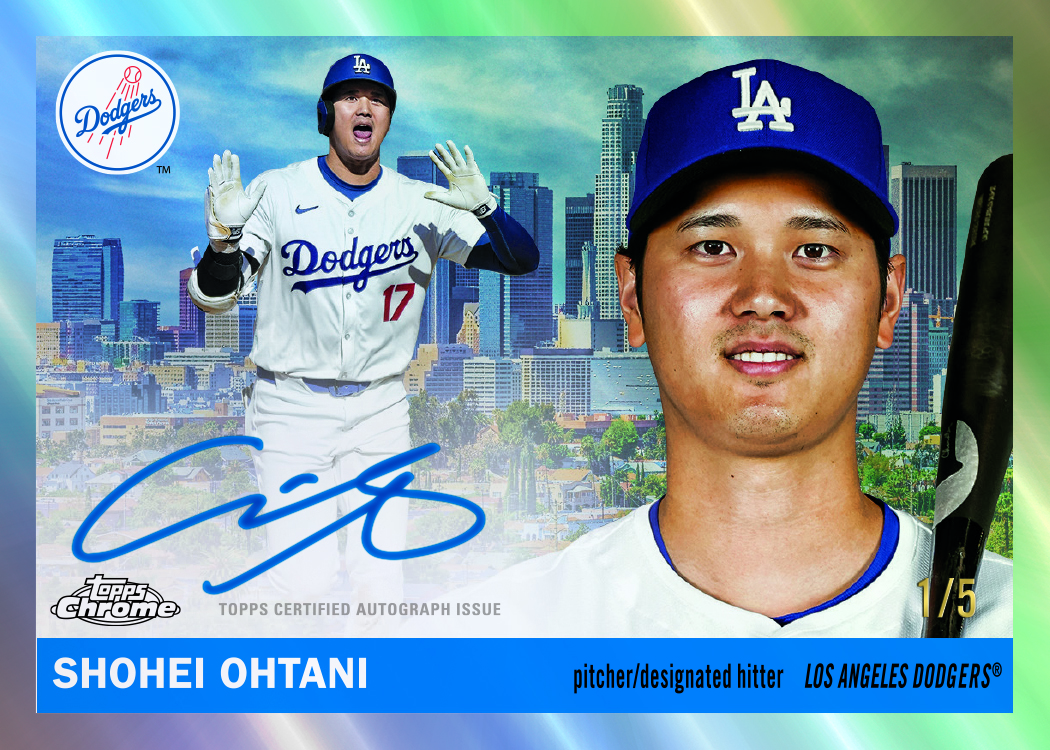
The City Variation autographs run long. Topps' checklist has 92 of them. The SuperFractor line puts about 103 one-of-ones in packs (54 in hobby and 49 in Value Boxes), 12 percent more than 92 cards can make. Neither the sheet nor our data has a run for the Refractor, but the Ohtani pictured above is numbered 1/5, and at /5 the line's 511 cards come to 102 signers' worth. Both lines point to about 102 cards, ten more than the checklist lists. Either Topps' odds count ten City Variation autographs that the checklist leaves off, or both lines are off by the same amount.
The cards with no print run
| Card | Cards | Where | Copies of each card |
|---|---|---|---|
| Base Red Prism | 500 | Value Box | about 1 (about 500 in all) |
| 1955 Topps City Variations Chrome Packs Autographs Refractor | 92 | Both | about 5.6 (about 511 in all) |
| 1955 Topps City Variations Chrome Packs Refractor | 80 | Hobby | about 11 |
| Base Gold Prism | 500 | Value Box | about 20 |
| 1955 Topps Employee Super Short Prints | 10 | Both | about 25 (about 250 in all) |
| 1955 Cards That Never Were Refractor | 20 | Hobby | about 44 |
| Base X-Fractor | 500 | Hobby | about 175 |
| Image Variation | 40 | Both | about 400 |
| 1955 Cards That Never Were | 20 | Hobby | about 440 |
| 1955 Topps City Variations Chrome Packs | 80 | Hobby | about 440 |
| Autographs | 178 | Both | about 525 |
| Base Blue Prism | 500 | Value Box | at least about 1,000 |
| Base Prism | 500 | Value Box | at least about 1,760 |
| Base Refractor | 500 | Both | at least about 2,800 |
| Base set | 500 | Both | at least about 11,200 |
| 1955 Topps Rails and Sails | 20 | Both | about 14,000 |
| 1955 Topps Double Headers | 20 | Both | about 14,000 |
| 1955 World Series | 10 | Both | about 56,000 |
Topps rounds its odds up, so every count here is a floor. On the long lines the difference is tiny, but the short ones can run well above it: up to a third more on the 1:4 Refractor and Prism, a sixth more on the 1:7 Blue Prism, about 11 percent more on the 1:10 World Series and about 5 percent more on the 1:20 lines, so treat those figures as minimums. The City Variation autograph Refractor works out to /5 on about 102 cards, as covered above.
The base set has a 1:1 line in every column, and with Topps rounding up, that means at least one base card per pack. That puts at least about 5.6 million base cards in packs, at least about 11,200 of each of the 500. The full count needs the number of cards in a pack, which Topps doesn't give for this product, so the base set can only be counted from below.
The scarcest cards with no serial number are the Red Prisms, at about one copy of each card, all from Value Box packs. Next come the City Variations Refractors at about 11 of each, the Gold Prisms at about 20, as scarce as a /20, and the Employee Super Short Prints at about 25, as scarce as an Orange /25. At the other end, a World Series base card is about 56,000 copies, four times as common as a Rails and Sails or Double Headers card.
The rarest pulls
The longest odds on the sheet are the World Series SuperFractor and the Employee Super Short Print SuperFractor, each 1:566,307 hobby packs and 1:559,228 Value Box packs. Each set has 10, and hobby packs hold about 3.7 of each set's 10.
Next are the Rails and Sails and Double Headers SuperFractors at 1:283,154 (20 cards each, about 7.4 in hobby), the Image Variation SuperFractor at 1:141,577 (40 cards, about 15 in hobby), the World Series Red /5 at 1:113,262 and the Cards That Never Were SuperFractor at 1:106,497, hobby only.
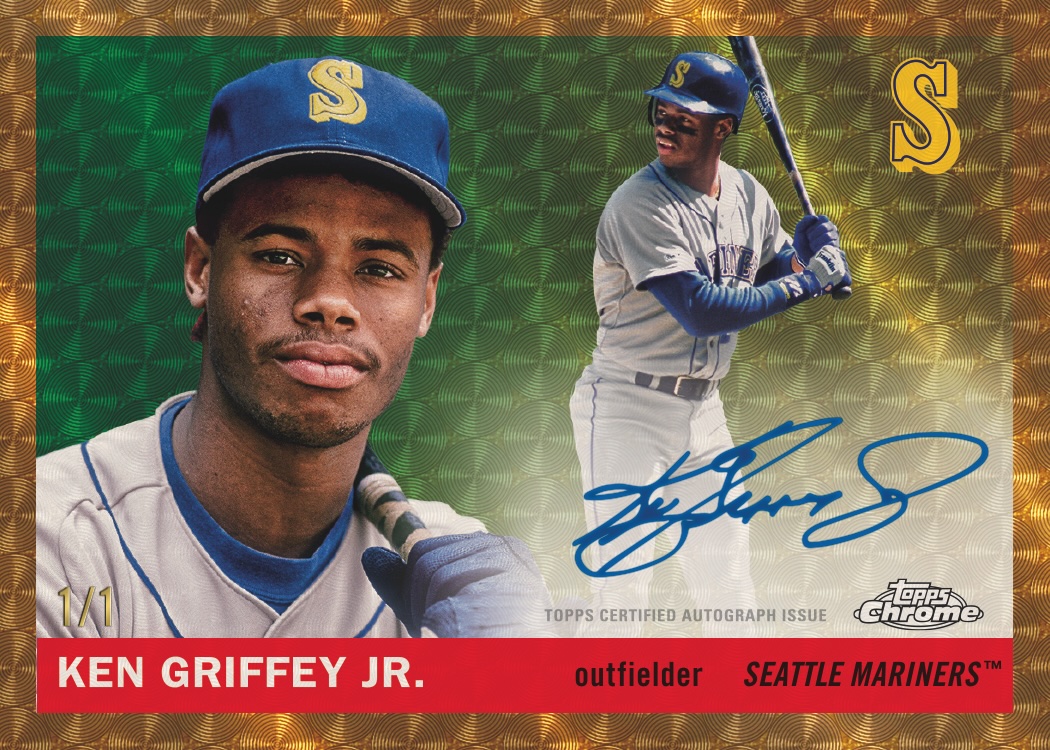
Across the product, the SuperFractor lines put about 968 one-of-ones in packs, against 970 on the checklist: all 500 base cards, all 40 Image Variations, nearly all 160 inserts, about 166 of the 178 autographs and about 103 City Variation autographs, 11 more than the checklist's 92. The autographs coming up short and the City Variation autographs running long nearly cancel out. Hobby packs hold about 462 of them, one about every 4,500 hobby packs, and Value Box packs about 505, one about every 7,000. A base SuperFractor alone is one every 11,327 hobby packs.
What to watch
The things we're watching: Topps' box configuration for the hobby box and the Value Boxes, and what the SE and EA columns stand for; ten more City Variation autographs, or a corrected line, since the odds fit about 102 cards; serial numbers on the Gold Prism and Red Prism, which the odds put at about 20 and one per card; serial numbers on the Employee Super Short Prints, which come to about 25 of each; and the two hobby-only Refractor lines that both read 1:2,400. We'll update this piece if any of that changes.
The full checklist and every parallel with its print run and odds are on the 2025 Topps Chrome Platinum Baseball release page, and you can track what you pull in HobbyMonitor Collections.
This is not financial advice. These are cards. The data and analysis are here to inform. You make your own calls.
This article was generated with the assistance of AI and reviewed before publishing. Always verify latest market data, stats, or news.
Published: June 2026