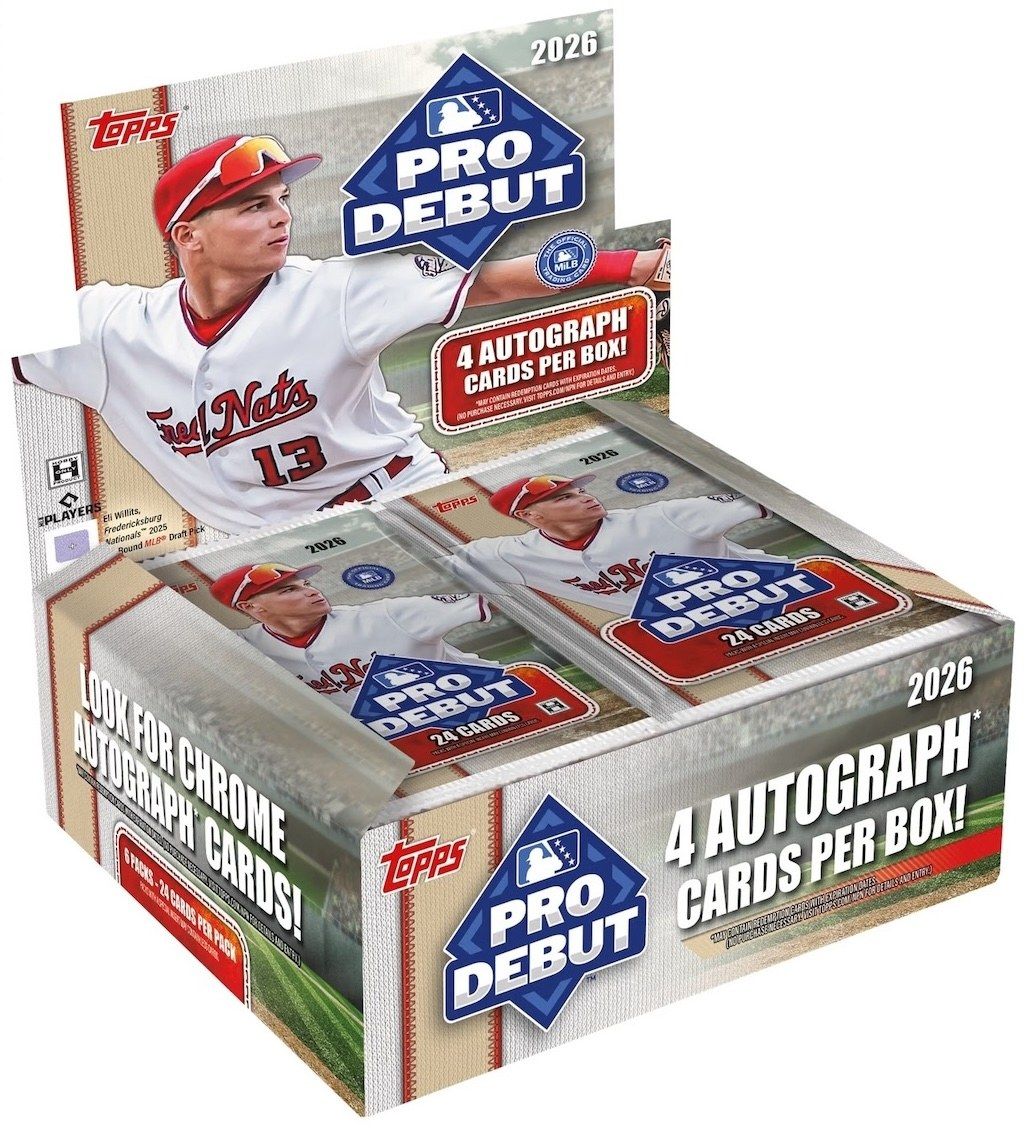
2026 Topps Pro Debut Baseball: The Complete Odds, Parallel, and Print Run Breakdown
2026 Topps Pro Debut Baseball goes on sale November 18 at noon ET, per Topps. The odds sheet is up on Topps' product page with a single column, labeled Jumbo, and it covers the hobby box: six packs of 24 cards with four autographs. The sheet prints no print runs and no pack count. But nine one-of-one lines land on whole cards at only one pack count, about 481,100 packs, or about 80,200 boxes. From there the odds check every numbered run on our release page, put a count on every card that has no run, and turn up a few things worth knowing before you open a box: about 96.5 percent of each numbered base and insert run is in packs, three insert one-of-ones per set are missing from the odds, and the smaller autograph sets run on a pack count about 1.5 percent bigger than the rest.
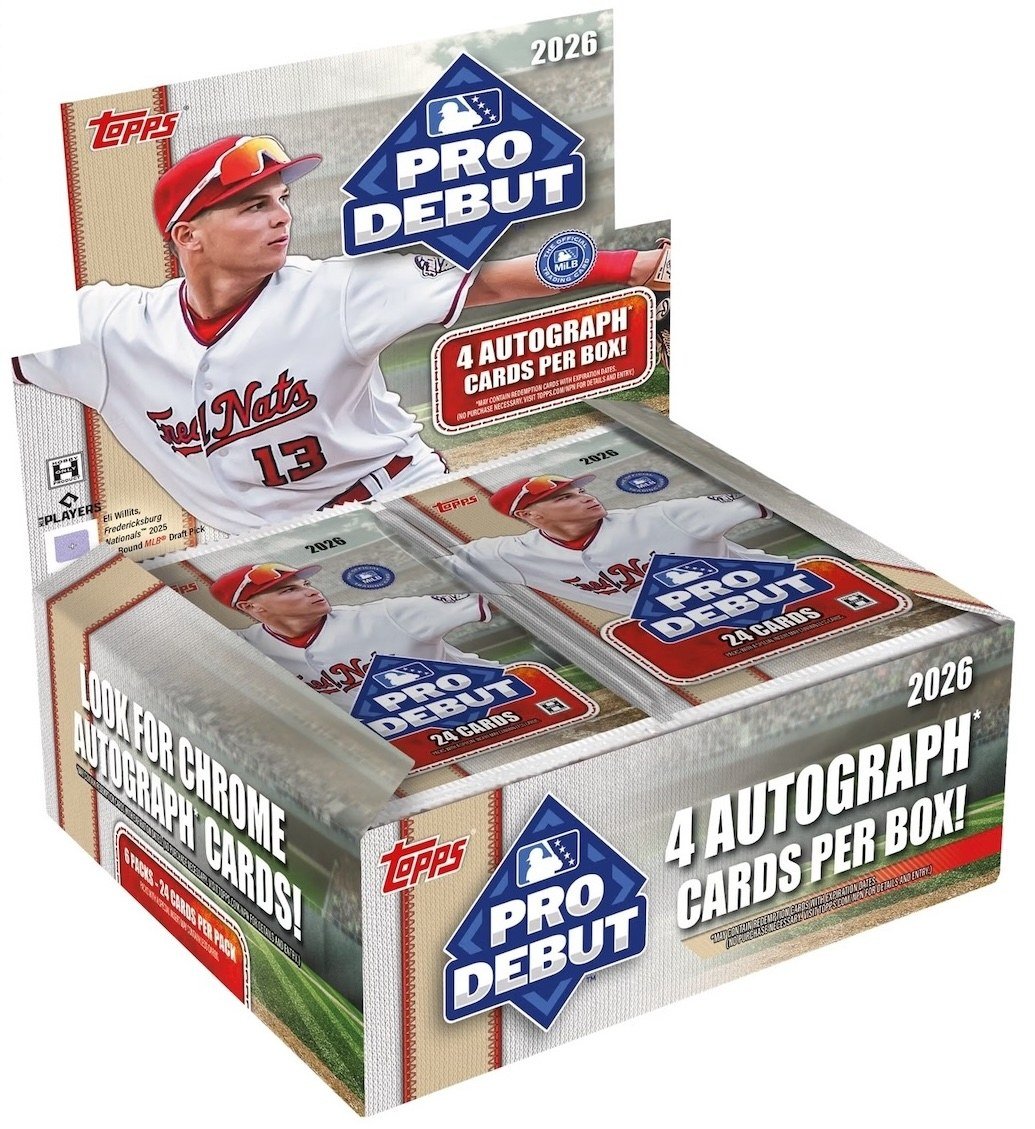
The box
Topps lists the hobby box at six packs of 24 cards, 144 cards, with four autographs a box. The box itself says the same ("4 autograph cards per box", "6 packs, 24 cards per pack") and adds "look for Chrome autograph cards". Topps' odds sheet labels its only column Jumbo, and it is the same box: add up every autograph line on the sheet and it comes to 0.6715 a pack, or 4.03 a box.
Here is what the odds put in an average box:
| Line | Per box |
|---|---|
| Base cards | about 89 |
| Base Card Chrome Variation (6 a pack) | 36 |
| Inserts, plain | about 8.5 |
| X-Fractor (Chrome, unnumbered) | 1 |
| Numbered base Foil parallels | 2.66 |
| Numbered Chrome parallels | 2.75 |
| Numbered insert parallels | 0.17 |
| Autographs | 4.03 |
The base card count is what's left of the 24 cards a pack once every other line on the sheet is taken out: 24 minus 9.18 is 14.8 base cards a pack, about 89 a box. That assumes each line on the sheet is its own card in the pack, which is how the sheet reads.
The four autographs break down like this:
| Autograph set | Per box | Or one every |
|---|---|---|
| Base Card Autographs, all versions | 2.91 | |
| Base Card Chrome Autograph Variation, every line on the sheet | 0.91 | 1.1 boxes |
| Pro Debut Jumbo Autograph Relic | 0.13 | 7.8 boxes |
| Future Cornerstones Autographs | 0.04 | 23 boxes |
| Pro Debut Gamers Autograph | 91 boxes | |
| 2025 Arizona Fall League Stars Autograph | 101 boxes | |
| Stars of MiLB Autograph | 109 boxes | |
| Pro Debut Dual Autographs | 158 boxes | |
| Pro Debut Triple Autographs | 179 boxes |
So the average box is about three Base Card Autographs and about one Chrome autograph. Everything else adds up to 0.21 a box, so roughly one box in five has an autograph from the smaller sets.
The checklist
The base set is 200 cards, PD-1 Eli Willits to PD-200 Bo Davidson, all minor leaguers on their minor league teams. The names include Konnor Griffin (#103), Kevin McGonigle (#109), JJ Wetherholt (#167), Travis Bazzana (#194), Ethan Holliday (#100), Jesús Made (#46), Leo De Vries (#144), Max Clark (#153), Walker Jenkins (#178) and Charlie Condon (#55).
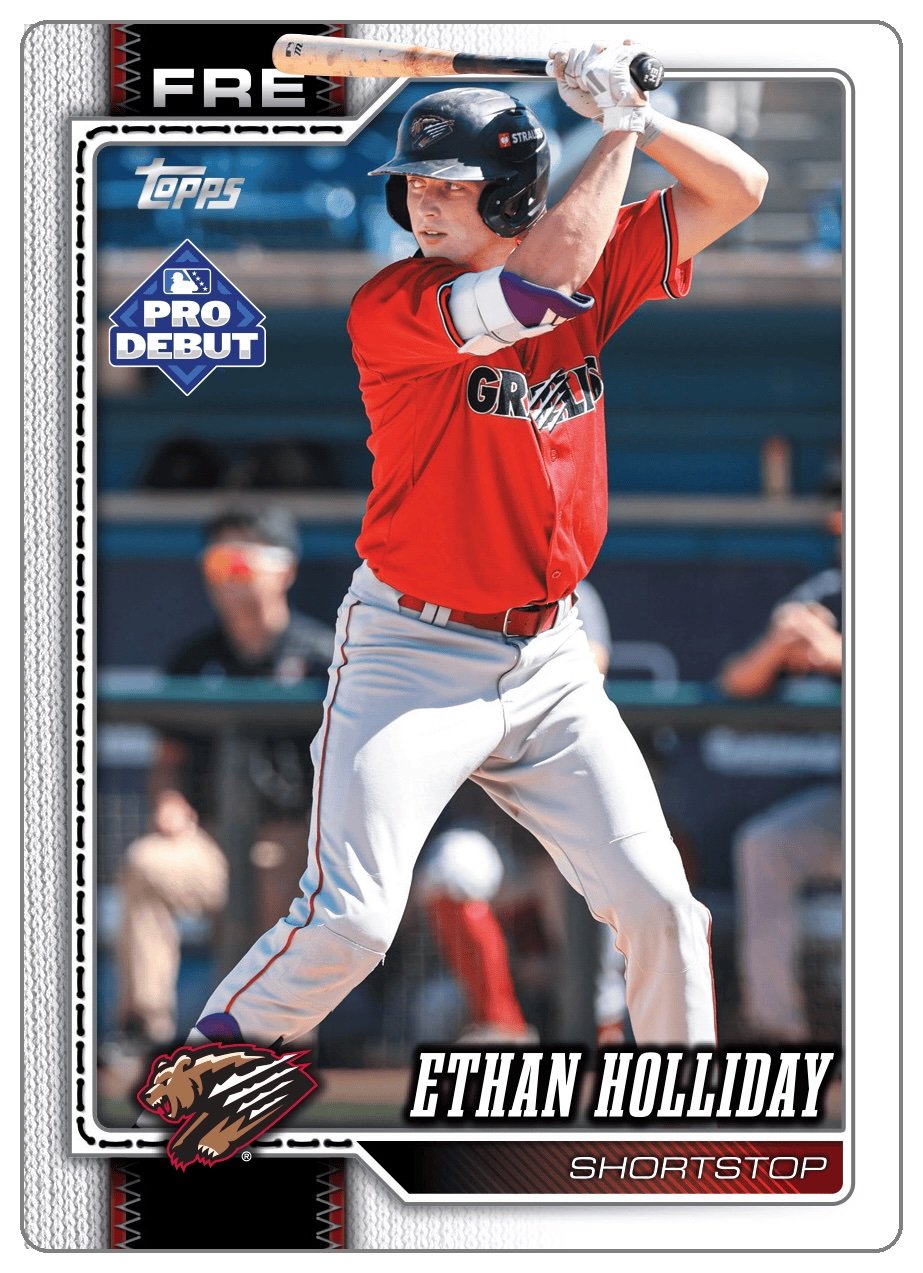
All 200 also come as a Base Card Chrome Variation, PDC-1 to PDC-200, at six a pack.
The inserts:
- 2025 Arizona Fall League Stars, 20 cards, new this year. The cards show the players on their fall league teams: McGonigle and Ethan Petry with the Scottsdale Scorpions, Condon and Jansel Luis with the Salt River Rafters, Tommy White with the Mesa Solar Sox.
- Pipeline Pairings, 24 cards, new, with two prospects from one organization on each card, such as Griffin and Seth Hernandez, Clark and McGonigle, Willits and Gavin Fien, and Condon and Holliday.
- Pro Debut Gamers, 24 cards, new.
- Stars of MiLB, 24 cards, returning, from Griffin, McGonigle and Wetherholt at #1 to #3 down to Jamie Arnold.
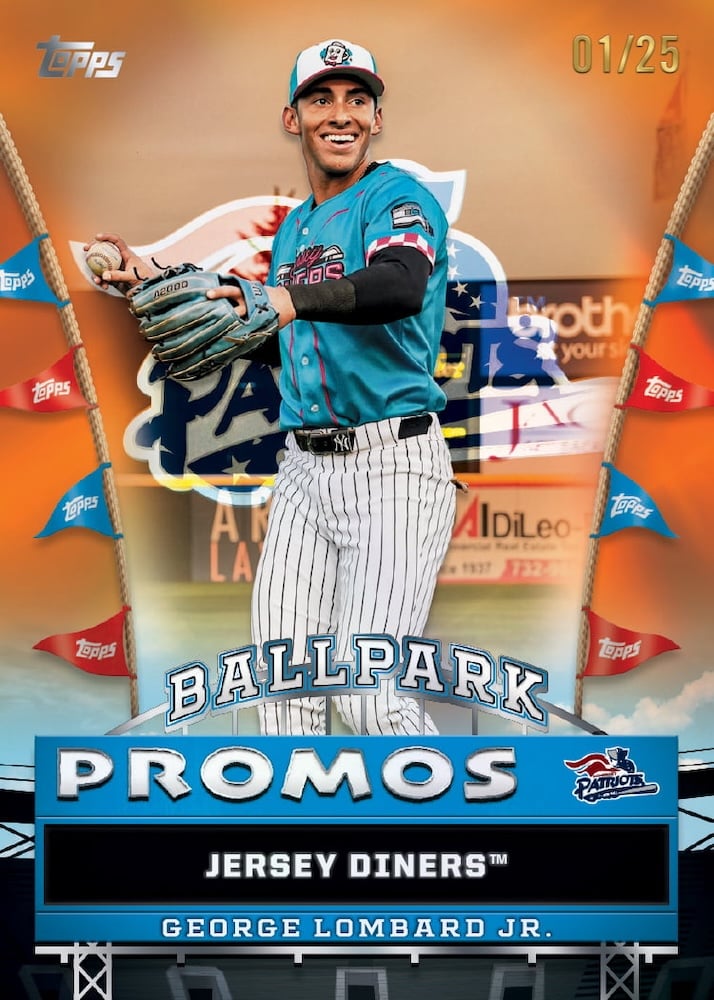
- Ballpark Promos, 22 cards, returning, built around minor league ballpark promotions. Topps' render of George Lombard Jr. below is a Somerset Patriots card branded Jersey Diners.
The autographs:
- Base Card Autographs, 172 of the 200 base players.
- Base Card Chrome Autographs, 159 of the 200.
- Future Cornerstones Autographs, 26 signers, including Griffin, McGonigle, Wetherholt, Made, De Vries, Willits, Holliday, Bazzana and Jenkins.
- Pro Debut Jumbo Autograph Relics, 21 signers, including Condon, McGonigle, Clark, Bazzana, Lombard and De Vries.
- Pro Debut Dual Autographs, 15 cards. Griffin is on two of them (with Hernandez and with McGonigle), and so is Willits (with Bazzana and with Holliday).
- Pro Debut Triple Autographs, 14 cards. Willits is on three, McGonigle on three, and Griffin and Holliday on two each.
- Autograph versions of three inserts: 2025 Arizona Fall League Stars (17 of the 20), Pro Debut Gamers (20 of the 24) and Stars of MiLB (19 of the 24).
In all, the checklist runs to 977 cards. McGonigle appears 16 times, counting each dual and triple he is on, Willits 15 times, and Griffin, Made and De Vries 13 times each.
How many packs
The sheet has one column, so every line counts the same packs. A one-of-one line with odds of 1 in N packs means N packs for each one-of-one in packs, so the pack count is N times the number of one-of-ones.
If every one-of-one were in packs, the lines would disagree. The base FoilFractor (1:2,493, 200 cards) would point to 498,600 packs, the Base Card Autograph FoilFractor (1:2,797, 172 signers) to 481,084, and the Stars of MiLB FoilFractor (1:22,910, 24 cards) to 549,840.
They agree at one pack count, about 481,100:
| One-of-one line | Odds | Checklist | At 481,100 packs |
|---|---|---|---|
| Base Card Autographs FoilFractor | 1:2,797 | 172 | 172.0 |
| Chrome Autographs SuperFractor | 1:3,026 | 159 | 159.0 |
| Base FoilFractor | 1:2,493 | 200 | 193.0 |
| Chrome Variation SuperFractor | 1:2,493 | 200 | 193.0 |
| 2025 Arizona Fall League Stars FoilFractor | 1:28,300 | 20 | 17.0 |
| Ballpark Promos FoilFractor | 1:25,321 | 22 | 19.0 |
| Pipeline Pairings FoilFractor | 1:22,910 | 24 | 21.0 |
| Pro Debut Gamers FoilFractor | 1:22,910 | 24 | 21.0 |
| Stars of MiLB FoilFractor | 1:22,910 | 24 | 21.0 |
All nine land within 0.02 of a whole card, well inside what the odds' rounding allows. The two autograph lines come out at exactly their checklists, 172 signers and 159 signers, which caps the count: at any more than about 481,200 packs the sheet would have more autograph one-of-ones than signers. We also searched every pack count from 300,000 to 700,000, asking only that all nine lines hold a whole number of cards no bigger than the checklist. The only counts that pass run from 481,100 to 481,108.
That is about 481,100 packs, or about 80,200 boxes of six. It's our figure from the odds, not one Topps has stated.
Ruling out the bigger count. If every numbered base run were in packs in full, the base ladder would point to about 498,600 packs (the base FoilFractor's 1:2,493 times 200). At that count there would be 178 Base Card Autograph one-of-ones for 172 signers and 165 Chrome Autograph SuperFractors for 159, and none of the insert FoilFractors would land on a whole card. So we use 481,100, and read the numbered tiers as a little short of full, as below.
The smaller autograph sets run a little higher. The seven smaller autograph sets (Future Cornerstones, the Jumbo Autograph Relics, the duals, the triples and the three insert autographs) don't land on whole cards at 481,100. Their one-of-ones come to 98.5 percent of each checklist. At about 488,400 packs, 1.5 percent more, every one of them lands exactly:
| One-of-one line | Odds | Checklist | At 488,400 packs |
|---|---|---|---|
| Future Cornerstones FoilFractor | 1:18,786 | 26 | 26.0 |
| Jumbo Autograph Relic SuperFractor | 1:23,259 | 21 | 21.0 |
| Pro Debut Gamers Autograph FoilFractor | 1:24,422 | 20 | 20.0 |
| Stars of MiLB Autograph FoilFractor | 1:25,707 | 19 | 19.0 |
| 2025 Arizona Fall League Stars Autograph FoilFractor | 1:28,731 | 17 | 17.0 |
| Dual Autographs FoilFractor | 1:32,562 | 15 | 15.0 |
| Triple Autographs FoilFractor | 1:34,888 | 14 | 14.0 |
The numbered tiers of Future Cornerstones, the duals and the triples also come out whole at 488,400 (below); the Jumbo Autograph Relic tiers don't, as the relic section shows. The sheet doesn't say why those seven sets were worked out on a different count, and it makes only a 1.5 percent difference, so we give their counts on 488,400 and everything else on 481,100.
The one-of-ones the odds don't account for
At 481,100 packs, the base FoilFractor and the Chrome SuperFractor are each 193 of 200, so seven of each are not accounted for. That fits the rest of the base ladder, which is about 96.5 percent in packs on every tier (next section).
The inserts are different. Their numbered tiers are 96.4 percent in packs like the base, which would be about 19 to 23 FoilFractors a set. The odds put three fewer than the checklist in every insert: 17 of 20 Arizona Fall League Stars, 19 of 22 Ballpark Promos, and 21 of 24 in each of Pipeline Pairings, Pro Debut Gamers and Stars of MiLB. That is 15 insert one-of-ones the odds don't account for. The sheet doesn't say which cards they are or whether they were made. Topps' note on the sheet says a subject is not guaranteed to appear in every parallel.
Every autograph one-of-one is accounted for (the seven smaller sets on the 488,400 count).
The base parallels
Topps prints no runs on the sheet. The runs below are the ones on our release page, and the odds check each one at 481,100 packs.
The base Foil ladder, 200 cards:
| Parallel | Run | Odds | In packs | Per card | Share of run |
|---|---|---|---|---|---|
| Purple Foil | /299 | 1:8 | about 60,100 | about 301 (283 to 321) | about 100% |
| Fuchsia Foil | /199 | 1:13 | about 37,000 | about 185 (178 to 192) | about 93% |
| Sparkle Foil | /175 | 1:14 | about 34,400 | about 172 (166 to 178) | about 98% |
| Blue Foil | /150 | 1:17 | about 28,300 | about 142 (137 to 146) | about 94% |
| Green Foil | /99 | 1:25 | about 19,200 | about 96 | 97% |
| Aqua Foil | /75 | 1:33 | about 14,600 | about 73 | 97% |
| Gold Foil | /50 | 1:50 | 9,622 | 48.1 | 96.2% |
| Orange Foil | /25 | 1:100 | 4,811 | 24.1 | 96.2% |
| Donut Foil | /15 | 1:166 | 2,898 | 14.5 | 96.6% |
| Red Foil | /10 | 1:249 | 1,932 | 9.7 | 96.6% |
| FoilFractor | 1/1 | 1:2,493 | 193 | 193 of 200 | 96.5% |
From Gold down, about 96.5 percent of every run is in packs, the same share as the one-of-ones. The long odds barely move with rounding, so those shares are tight. The top four tiers have short, rounded odds (1:8 could be anything from 1:7.5 to 1:8.5), so their shares swing more, but each range takes in about 96.5 percent. The sheet doesn't say where the other 3.5 percent of each run goes.
Every run on our page fits. The Sparkle /175 and Fuchsia /199 sit where they should, Fuchsia at 1:13 and Sparkle at 1:14, and no run is off by more than its odds' rounding.
The Chrome ladder, 200 Chrome Variation cards:
| Parallel | Run | Odds | Per card in packs |
|---|---|---|---|
| X-Fractor | no run | 1:6 | about 400 (370 to 437) |
| Refractor | /199 | 1:13 | about 185 |
| Blue Refractor and Blue Wave | /150 each | 1:17 | about 142 |
| Purple Refractor | /125 | 1:20 | about 120 |
| Green Refractor and Green Wave | /99 each | 1:25 | about 96 |
| Aqua Refractor and Aqua Wave | /75 each | 1:33 | about 73 |
| Gold Refractor and Gold Mini Diamond | /50 each | 1:50 | 48.1 |
| Orange Refractor and Orange Mini Diamond | /25 each | 1:100 | 24.1 |
| Black Refractor and Black Wave | /10 each | 1:249 | 9.7 |
| Red Refractor and Red Mini Diamond | /5 each | 1:499 | 4.8 |
| SuperFractor | 1/1 | 1:2,493 | 193 of 200 |
The pairs share odds exactly, so each pair is two runs of the same size, and the shares match the Foil ladder: about 96.5 percent in packs. The Purple Refractor /125 has no Foil twin, and at 120 a card (96.2 percent) it fits too.
The X-Fractor carries no run on our page. At 1:6 it is one a box, about 80,200 in the product and about 400 of each card.
If the runs hold, each base card has 1,098 numbered Foil copies and 1,153 numbered Chrome copies printed, and about 96.5 percent of them are in packs.
The base cards
The base card. With about 14.8 base cards a pack, the odds put about 7.1 million base cards in packs, about 35,600 of each of the 200 (roughly 35,000 to 36,000, depending on how the short insert odds round).
The Base Card Chrome Variation is printed on the sheet as 6:1, six a pack. That is about 2.9 million cards, about 14,400 of each.
The inserts
All five inserts share one ladder: Green, Orange and FoilFractor. Our page lists the Green at /99 and the Orange at /25, and Topps' own render of the Lombard Ballpark Promos below is orange and numbered 01/25.
| Insert | Cards | Plain | Green /99 | Orange /25 | FoilFractor 1/1 |
|---|---|---|---|---|---|
| 2025 Arizona Fall League Stars | 20 | 1:4 | 1:252, about 1,909 | 1:998, about 482 | 1:28,300, 17 |
| Ballpark Promos | 22 | 1:3 | 1:229, about 2,101 | 1:908, about 530 | 1:25,321, 19 |
| Pipeline Pairings | 24 | 1:3 | 1:210, about 2,291 | 1:831, about 579 | 1:22,910, 21 |
| Pro Debut Gamers | 24 | 1:3 | 1:210, about 2,291 | 1:831, about 579 | 1:22,910, 21 |
| Stars of MiLB | 24 | 1:6 | 1:210, about 2,291 | 1:831, about 579 | 1:22,910, 21 |
Per card that is 95.5 Greens and 24.1 Oranges on every insert, 96.4 percent of a /99 and a /25. Both runs fit.
The plain versions:
| Insert | Cards | Odds | In packs | Per card |
|---|---|---|---|---|
| Ballpark Promos | 22 | 1:3 | about 160,400 | about 7,300 (6,250 to 8,750) |
| Pipeline Pairings | 24 | 1:3 | about 160,400 | about 6,700 (5,700 to 8,000) |
| Pro Debut Gamers | 24 | 1:3 | about 160,400 | about 6,700 (5,700 to 8,000) |
| 2025 Arizona Fall League Stars | 20 | 1:4 | about 120,300 | about 6,000 (5,350 to 6,850) |
| Stars of MiLB | 24 | 1:6 | about 80,200 | about 3,350 (3,100 to 3,650) |
The ranges are wide because 1:3 and 1:4 are heavily rounded. Stars of MiLB is the one to notice: at one a box, it is about half as common per card as the other four.
The autographs
The odds put about 323,000 autographs in packs, four a box.
Base Card Autographs, 172 signers. The plain version is 1:5, about 96,200 cards, about 560 of each signer (510 to 620). It has the same 11 parallels as the base set, and here the odds get longer much more slowly than the runs get smaller: the Purple /299 is 1:16, but the Blue /150, half the run, is only 1:24. That happens when a parallel exists for only some of the signers. Dividing the cards in packs by the run gives the number of signers each tier covers, if the autograph runs match the base set's:
| Parallel | Run | Odds | In packs | Signers covered |
|---|---|---|---|---|
| Purple Foil | /299 | 1:16 | about 30,100 | about 101 |
| Fuchsia Foil | /199 | 1:21 | about 22,900 | about 115 |
| Sparkle Foil | /175 | 1:23 | about 20,900 | about 120 |
| Blue Foil | /150 | 1:24 | about 20,000 | about 134 |
| Green Foil | /99 | 1:33 | about 14,600 | about 147 |
| Aqua Foil | /75 | 1:41 | about 11,700 | about 157 |
| Gold Foil | /50 | 1:59 | about 8,150 | about 163 |
| Orange Foil | /25 | 1:116 | about 4,150 | about 166 |
| Donut Foil | /15 | 1:189 | about 2,550 | about 170 |
| Red Foil | /10 | 1:284 | about 1,690 | about 169 |
| FoilFractor | 1/1 | 1:2,797 | 172 | 172 |
The FoilFractor is all 172, so the autograph runs look to be in packs in full, unlike the base set's. Read the signer counts as about: they assume the autograph runs match the base set's. What the table does show is the shape. Nearly every signer has the bottom four tiers, and only about 100 of the 172 have a Purple.
Base Card Chrome Autographs, 159 signers.
| Version | Run | Odds | In packs | Signers covered |
|---|---|---|---|---|
| Refractor | /199 | 1:19 | about 25,300 | about 127 |
| Blue | /150 | 1:24 | about 20,000 | about 134 |
| Green | /99 | 1:35 | about 13,700 | about 139 |
| Gold | /50 | 1:65 | about 7,400 | about 148 |
| Orange | /25 | 1:129 | about 3,730 | about 149 |
| Black | /10 | 1:307 | about 1,570 | about 157 |
| Red | /5 | 1:614 | about 784 | about 157 |
| SuperFractor | 1/1 | 1:3,026 | 159 | 159 |
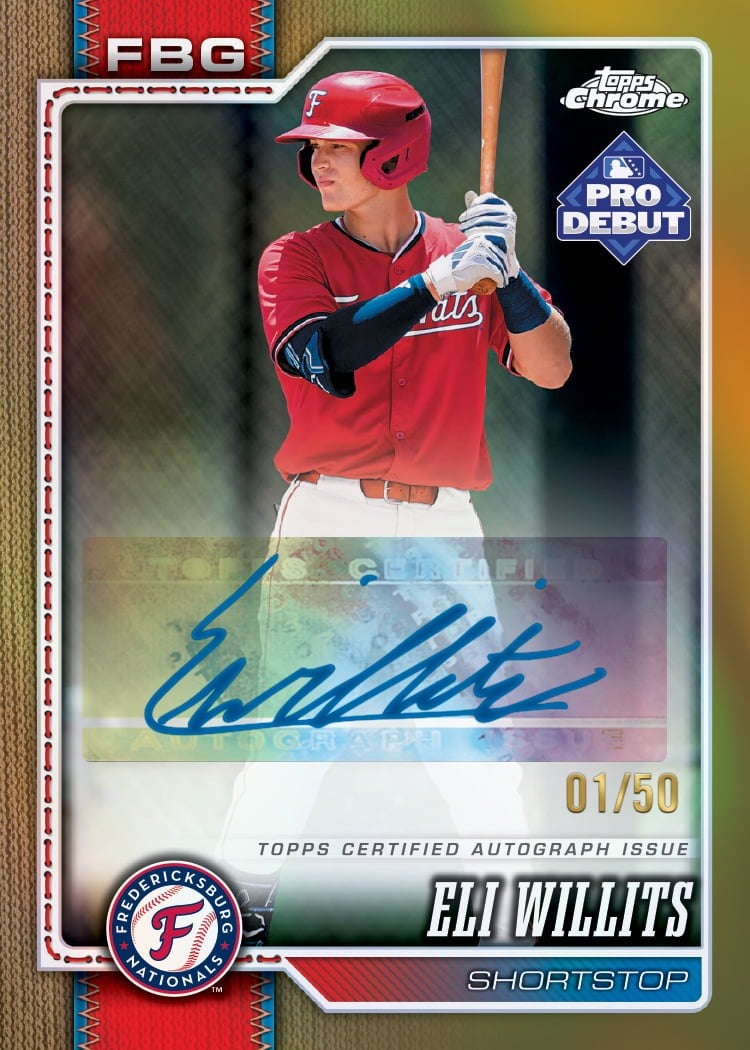
The Willits above is a Gold, numbered 01/50.
The first Chrome autograph line is the Refractor /199. The sheet lists it as the plain "Base Card Chrome Autograph Variation" at 1:19, about 25,300 cards, which at 199 copies covers about 127 signers. That fits the pattern of the tiers below it (134 for the Blue, 139 for the Green): like the other ladders in this set, not every signer has every parallel.
A Chrome autograph of some kind falls about once a box (0.91 a box).
The smaller sets are worked out on about 488,400 packs. There Future Cornerstones, the duals, the triples and the insert autograph one-of-ones come out whole; the Jumbo Autograph Relic parallels do not.
Future Cornerstones Autographs, 26 signers:
| Version | Run | Odds | In packs | Signers covered |
|---|---|---|---|---|
| Plain | no run on our page | 1:308 | about 1,590 | about 61 each |
| Gold Foil | /50 | 1:465 | 1,050 | 21 |
| Orange Foil | /25 | 1:849 | 575 | 23 |
| Red Foil | /5 | 1:1,879 | 130 | 26 |
| FoilFractor | 1/1 | 1:18,786 | 26 | 26 |
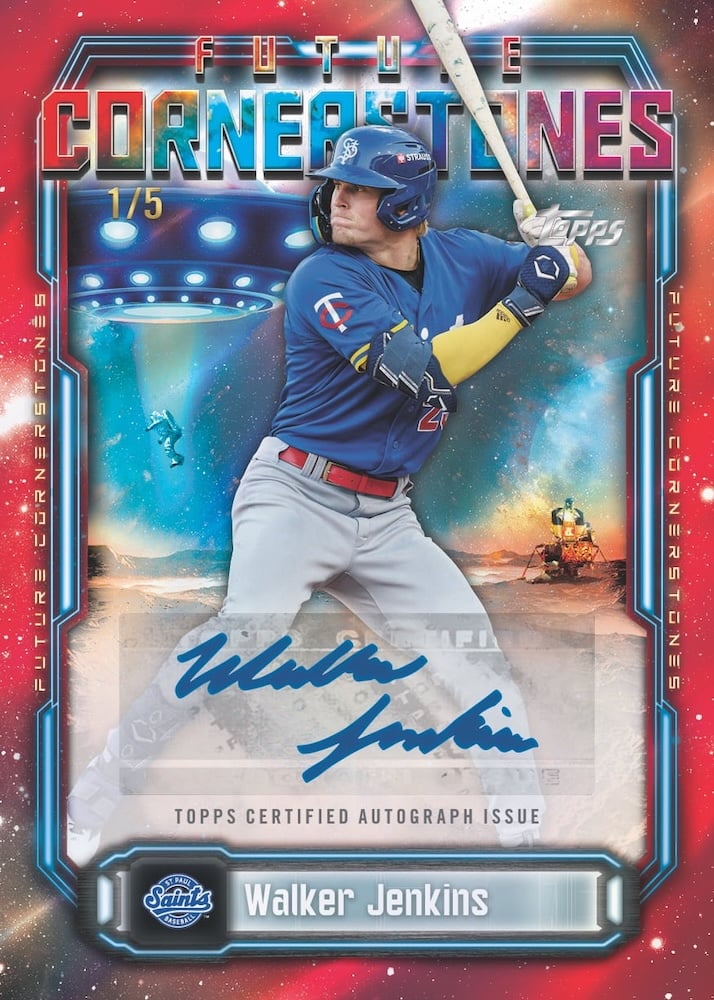
Topps' render of the Red, the Jenkins above, is numbered 1/5, so the Red is a /5: 130 cards across the 26 signers. The odds line doesn't fit that. At 1:1,879 the sheet works out to about 260 Reds, twice the 130 that exist, so either the line is stated for a larger run or not every Red is in packs the way the sheet's other lines suggest.
Pro Debut Jumbo Autograph Relics, 21 signers. The plain version is 1:104, about 4,700 cards, about 224 of each.
| Parallel | Run | Odds | In packs | Signers covered |
|---|---|---|---|---|
| Blue | /150 | 1:208 | about 2,350 | about 16 |
| Green | /99 | 1:314 | about 1,560 | about 16 |
| Gold | /50 | 1:468 | about 1,040 | about 21 |
| Orange | /25 | 1:969 | about 504 | about 20 |
| Black | /10 | 1:2,394 | about 204 | about 20 |
| Red | /5 | 1:4,836 | about 101 | about 20 |
| SuperFractor | 1/1 | 1:23,259 | 21 | 21 |
These are the loosest fits in the product. The Gold, Orange, Black and Red land between 20 and 21 signers rather than on a whole number, so either a signer or two skips a tier or a run isn't quite what our page says. The Blue and Green cover about 16 signers.
Pro Debut Dual Autographs, 15 cards, and Pro Debut Triple Autographs, 14 cards.
| Version | Run | Duals: odds, in packs | Triples: odds, in packs |
|---|---|---|---|
| Base | /25 | 1:1,396, 350 | 1:1,628, 300 |
| Red Foil | /10 | 1:3,256, 150 | 1:3,489, 140 |
| FoilFractor | 1/1 | 1:32,562, 15 | 1:34,888, 14 |
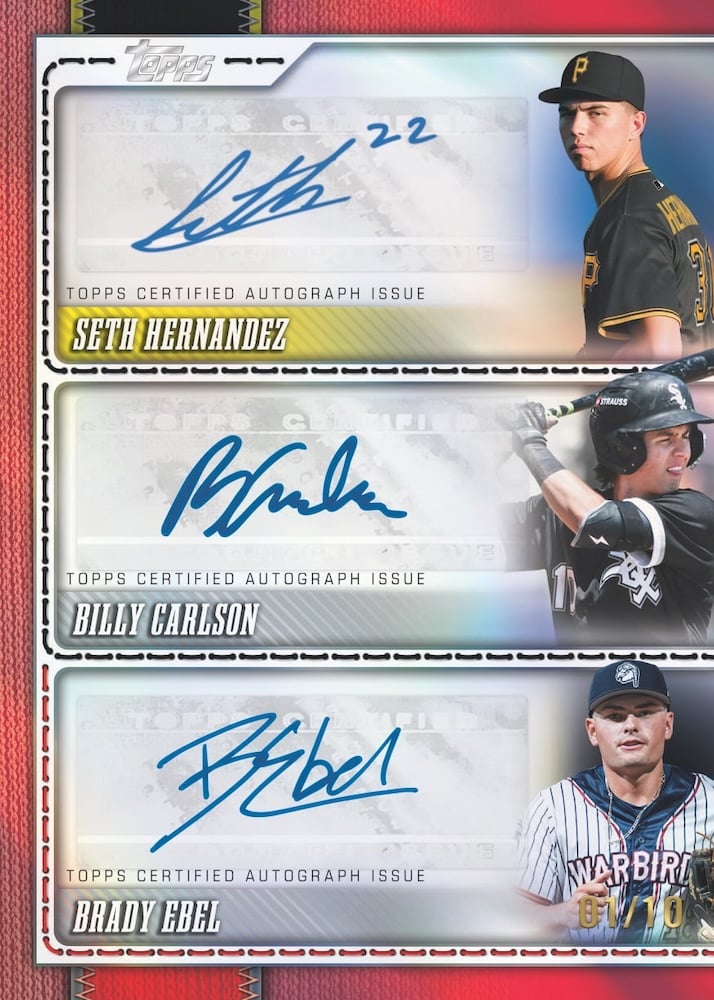
The Red and the FoilFractor cover every card: 15 and 14. The base version doesn't. At /25, 350 duals is 14 of the 15 cards and 300 triples is 12 of the 14. So about one dual and two triples have no base version in packs, or the base run is not 25. Topps' render of the Hernandez, Carlson and Ebel triple, above, is a Red numbered 01/10.
A dual of any version falls about once every 158 boxes and a triple about once every 179. In the whole product that is about 515 duals and 454 triples.
The insert autographs have two versions each, a plain version with no run on our page and a FoilFractor.
| Set | Signers | Plain odds | Plain in packs | Per signer | FoilFractor |
|---|---|---|---|---|---|
| Pro Debut Gamers Autograph | 20 | 1:558 | about 875 | about 44 | 1:24,422, 20 |
| 2025 Arizona Fall League Stars Autograph | 17 | 1:622 | about 785 | about 46 | 1:28,731, 17 |
| Stars of MiLB Autograph | 19 | 1:674 | about 725 | about 38 | 1:25,707, 19 |
The cards with no print run
| Card | Cards | In packs | Copies of each |
|---|---|---|---|
| Base card | 200 | about 7.1 million | about 35,600 |
| Base Card Chrome Variation | 200 | about 2.9 million | about 14,400 |
| Chrome X-Fractor | 200 | about 80,200 | about 400 |
| Ballpark Promos | 22 | about 160,400 | about 7,300 |
| Pipeline Pairings | 24 | about 160,400 | about 6,700 |
| Pro Debut Gamers | 24 | about 160,400 | about 6,700 |
| 2025 Arizona Fall League Stars | 20 | about 120,300 | about 6,000 |
| Stars of MiLB | 24 | about 80,200 | about 3,350 |
| Base Card Autographs | 172 | about 96,200 | about 560 |
| Chrome Autograph plain line, if unnumbered | 159 | about 25,300 | about 159 |
| Pro Debut Jumbo Autograph Relic | 21 | about 4,700 | about 224 |
| Future Cornerstones Autographs | 26 | about 1,590 | about 61 |
| 2025 Arizona Fall League Stars Autograph | 17 | about 785 | about 46 |
| Pro Debut Gamers Autograph | 20 | about 875 | about 44 |
| Stars of MiLB Autograph | 19 | about 725 | about 38 |
Every other line on the sheet carries a run on our page and is covered above.
The rarest pulls
The longest odds on the sheet are the Triple Autographs FoilFractor at 1:34,888 and the Dual Autographs FoilFractor at 1:32,562, then the 2025 Arizona Fall League Stars Autograph FoilFractor at 1:28,731 and the plain Arizona Fall League Stars FoilFractor at 1:28,300. At six packs a box, the triple one-of-one is about one in every 5,800 boxes.
By count in packs, the thinnest lines are the 14 triple one-of-ones and the 15 dual one-of-ones, then the 17s: the Arizona Fall League Stars FoilFractor and its autograph version.
After the one-of-ones, the thinnest lines by total count are the Jumbo Autograph Relic Red at about 101 cards, the triple Red at 140 and the dual Red at 150. Among lines with no run on our page, the thinnest are the plain Stars of MiLB Autograph at about 38 of each signer, the Gamers and Arizona Fall League autographs at 44 to 46, and the Future Cornerstones plain at about 61. If those cards carry no serial number, nothing on them says how scarce they are.
A one-of-one of any kind falls about once every 509 packs, about one every 85 boxes. There are about 950 in packs.
What to watch
- Which Chrome autograph signers have a Refractor /199, about 127 of the 159.
- The Future Cornerstones Red /5, and why its odds read as if twice as many were printed.
- The 15 insert FoilFractors the odds don't account for, three in every insert, and the seven base FoilFractors and seven Chrome SuperFractors.
- The 3.5 percent of each numbered base and insert run that the odds leave out of packs.
- The dual and triple base versions, and which dual and two triples skip them if the run is /25.
- Which autograph signers skip which parallels, above all the roughly 100 of 172 with a Purple Foil autograph and the 16 or so with a Jumbo Autograph Relic Blue or Green.
- The 1.5 percent gap between the pack count for the smaller autograph sets and everything else.
We'll update this piece if any of that changes. Odds are Topps' intended configuration at the time of production, and actual contents can vary.
The full checklist and every parallel are on the 2026 Topps Pro Debut Baseball release page, and you can track what you pull in HobbyMonitor Collections.
This is not financial advice. These are cards. The data and analysis are here to inform. You make your own calls.
This article was generated with the assistance of AI and reviewed before publishing. Always verify latest market data, stats, or news.
Published: November 2026